Why Learning Your Mother Tongue Matters More Than Ever
Author: Jay Gala | Date: May 20, 2026
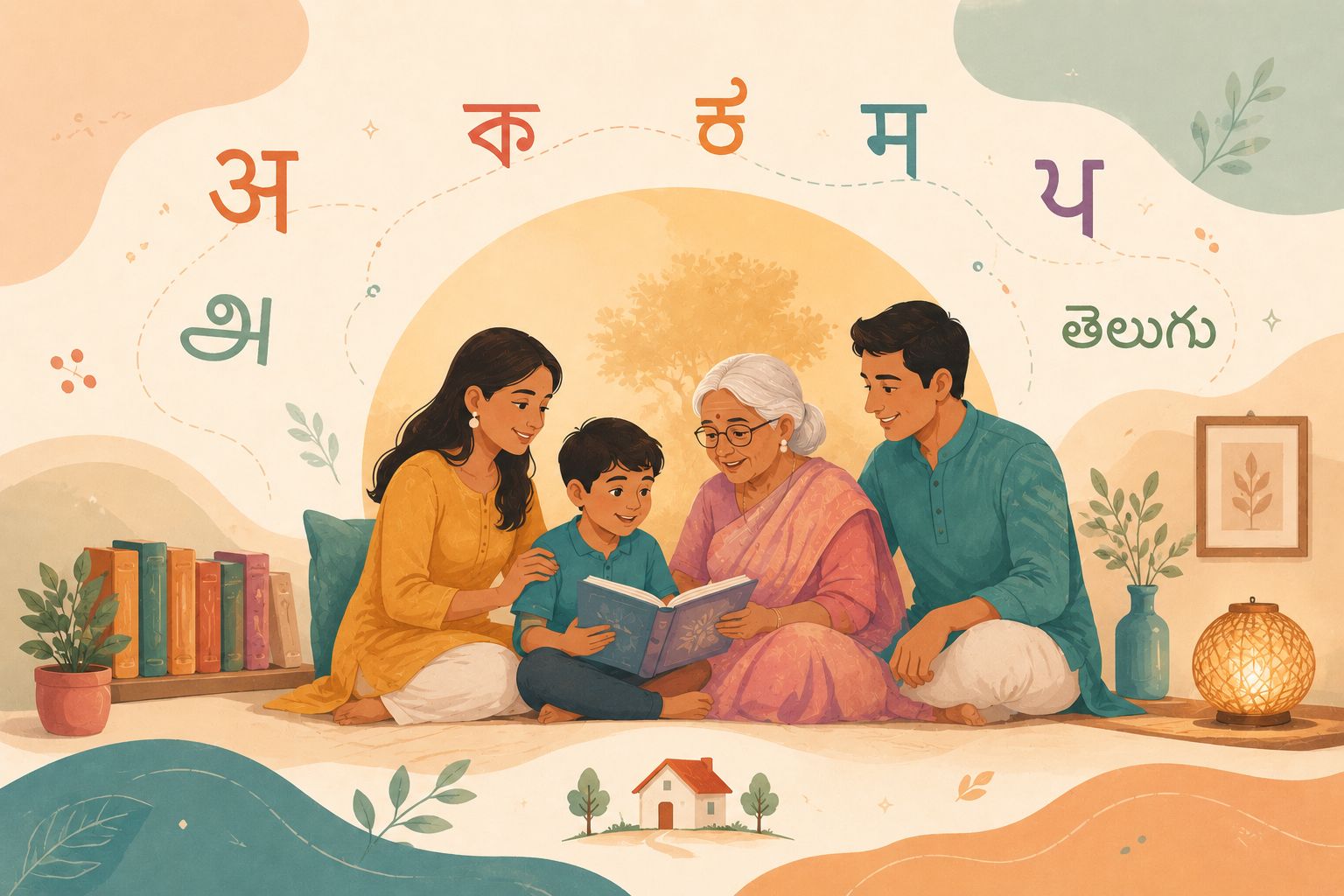
We live in a world that rewards English. Job interviews, university admissions, global business, the internet — English is the default. And for millions of Indians, the message has been clear: learn English, get ahead, and if your mother tongue has to take a back seat, so be it.
But something is being lost in this trade-off. And it's bigger than most people realize.
The Quiet Disappearance
Every two weeks, a language dies somewhere in the world. India alone has lost dozens of languages in the last century. But it's not just obscure tribal languages that are fading. Mainstream Indian languages — languages spoken by millions — are losing ground in homes, schools, and daily life.
The pattern is familiar: parents speak Tamil at home but send kids to English-medium schools. The kids grow up speaking English with friends, consuming English content, and gradually losing fluency in Tamil. By the next generation, Tamil becomes the language grandparents speak — understood but not spoken, recognized but not lived.
This isn't just happening with Tamil. It's happening with Bengali in Kolkata, Kannada in Bengaluru, Marathi in Mumbai, and Telugu in Hyderabad. Every Indian language is experiencing some version of this generational fade.
What You Lose When You Lose a Language
Identity
Your mother tongue is the first language your brain learned to think in. It's the language of your earliest memories, your family's inside jokes, the lullabies that put you to sleep, and the stories your grandparents told. When you lose fluency in your mother tongue, you don't just lose vocabulary — you lose a part of who you are.
Ask any NRI (Non-Resident Indian) who grew up abroad without learning their parents' language. The most common regret isn't about career or education. It's: "I wish I could speak to my grandparents in their language."
Cognitive Advantage
Research consistently shows that bilingual and multilingual individuals have cognitive advantages:
- Better executive function. Switching between languages strengthens the brain's ability to focus, filter distractions, and multitask.
- Delayed cognitive decline. Studies from the Centre for Neural and Cognitive Sciences at the University of Hyderabad show that bilingual Indians show symptoms of dementia 4-5 years later than monolinguals.
- Enhanced problem-solving. Multilingual brains are better at seeing problems from multiple perspectives — literally, because different languages frame concepts differently.
- Easier acquisition of additional languages. Children who maintain their mother tongue while learning English actually learn English better than children who abandon their mother tongue early.
That last point is worth repeating: keeping your mother tongue doesn't hurt your English — it actually helps it. The common fear that "too many languages will confuse the child" has been thoroughly debunked by decades of linguistic research.
Cultural Access
Every language encodes a unique way of seeing the world. Tamil has words for family relationships that English doesn't — separate words for maternal uncle (mama) and paternal uncle (periyappa/chithappa), each carrying different social expectations. Hindi's "jugaad" (जुगाड़) captures an entire philosophy of creative problem-solving that no English word adequately translates. Bengali's "obhiman" (অভিমান) describes a specific kind of silent, wounded pride that English has no equivalent for.
When you lose a language, you lose access to these concepts. You lose the ability to read literature in the original, to understand song lyrics without translation, to catch the wordplay in films, and to truly participate in cultural rituals that are conducted in the mother tongue.
Family Connection
This is the one that hits hardest. Language is the bridge between generations. When children can't speak their grandparents' language:
- Conversations become shallow — limited to "How are you?" and "Eat more"
- Stories, wisdom, and family history can't be passed down naturally
- Grandparents feel isolated in their own families
- Children miss out on the warmth, humor, and emotional depth that only comes through the native language
No amount of Google Translate can replace the bond that forms when a grandchild speaks to their grandmother in her own language.
The Myth of "English or Mother Tongue"
The biggest misconception in Indian education is that English and the mother tongue are competing priorities — that time spent on one takes away from the other. This is simply not true.
Research from around the world, including India, consistently shows:
- Strong mother tongue foundation improves learning in all languages, including English. Children who are literate in their mother tongue develop transferable skills — reading strategies, grammatical awareness, vocabulary building techniques — that accelerate learning in any language.
- Mother tongue-based education improves overall academic performance. The UNESCO Global Education Monitoring Report and India's own National Education Policy 2020 both emphasize the importance of mother tongue instruction, especially in early years.
- The most successful multilingual countries — Singapore, Switzerland, Finland — don't force a choice. They teach multiple languages simultaneously, with the mother tongue as the foundation.
India's NEP 2020 explicitly recommends instruction in the mother tongue or regional language until at least Grade 5, with the three-language formula enabling multilingual competency. The policy recognizes what research has long confirmed: the mother tongue is not an obstacle to English — it's the foundation for all learning.
For NRIs and the Indian Diaspora
If you're raising children outside India, the pressure to prioritize English (or the local language) is even more intense. But maintaining your mother tongue at home is one of the most valuable gifts you can give your children:
- It gives them roots. In a world where diaspora children often feel caught between cultures, language provides a concrete, undeniable connection to their heritage.
- It opens doors in India. As India's economy grows, Hindi, Tamil, Telugu, and other Indian languages become increasingly valuable professional assets.
- It builds resilience. Studies show that children with strong cultural and linguistic identity have better mental health outcomes and stronger self-esteem.
- It connects them to community. Temple visits, cultural events, family gatherings, and festivals are all richer when children can participate in the language, not just observe.
Practical tips for diaspora families:
- Speak the mother tongue exclusively at home — children will learn the dominant language at school regardless
- Video calls with grandparents in the mother tongue (the best free language lesson there is)
- Watch age-appropriate content in the mother tongue — cartoons, movies, YouTube channels
- Use language learning apps like Indilingo that teach from the mother tongue, reinforcing both languages simultaneously
- Connect with local Indian community groups where the language is spoken
It's Not Too Late
If you've already lost some fluency in your mother tongue, or if your children speak more English than your native language, it's not too late. Languages can be relearned. Heritage speakers (people who grew up hearing the language but didn't actively learn it) often recover fluency remarkably quickly because the neural pathways are still there, dormant but intact.
Even starting with 15 minutes a day — a lesson on Indilingo, a song in your language, a phone call to parents in the mother tongue instead of English — rebuilds connections that seemed lost.
What Indilingo Is Doing About It
This is exactly why we built Indilingo the way we did. Our core design principle — learn any language from your mother tongue — exists because we believe your native language is not an obstacle to learning. It's the foundation.
A Kannada speaker learning Hindi on Indilingo gets the entire experience in Kannada. A Tamil speaker learning English sees instructions, explanations, and support in Tamil. We don't force anyone through English as an intermediary, because that's not how the brain works best.
We're building Indilingo to make every Indian language accessible, not just to preserve them as museum artifacts, but to keep them alive, spoken, and loved by the next generation.
Your Mother Tongue Is Worth Fighting For
In a world that increasingly speaks one language, choosing to maintain your mother tongue is a quiet act of resistance. It's saying: this language matters. This culture matters. These stories, these songs, these words that have no translation — they matter.
Teach your children your language. Call your parents in their language. Read a book, watch a movie, sing a song in the language that first taught you to think.
Your mother tongue is not holding you back. It's the deepest part of who you are.
Start your journey with Indilingo.
Download for free on the Google Play Store.
Follow us on Instagram, X (Twitter), and LinkedIn.
Loved the Blog?
Take your language learning journey a step further.
Explore Indilingo - beautifully designed, easy to use, and built for Indian languages.