Tribal Languages of India: The Hidden Linguistic Treasure Most Indians Don't Know About
Author: Jay Gala | Date: May 20, 2026
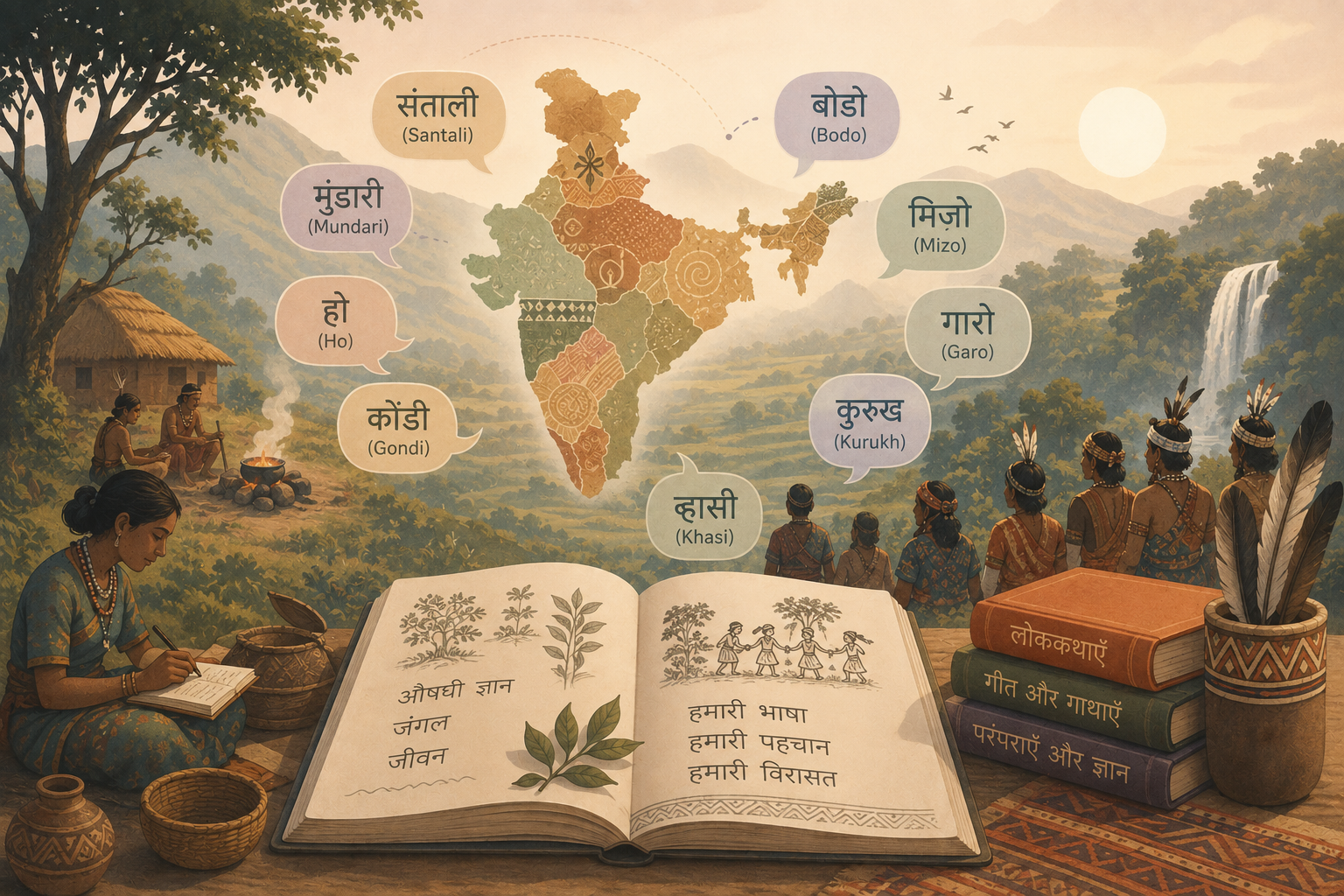
When people talk about Indian languages, they usually mean Hindi, Tamil, Bengali, Telugu — the big scheduled languages taught in schools and spoken in cities. But beneath this visible layer lies an astonishing hidden world: over 700 tribal languages spoken by more than 100 million people across India's forests, hills, and remote communities.
Most Indians can't name a single tribal language. Most have never heard one spoken. And yet, these languages contain thousands of years of ecological knowledge, oral literature, medicinal wisdom, and cultural traditions that exist nowhere else on Earth.
This is their story.
The Scale: How Many Tribal Languages Does India Have?
The exact number depends on how you count (the line between "language" and "dialect" is always debated), but the most cited figures are staggering:
- The People's Linguistic Survey of India (PLSI) documented 780 languages across India, the majority of which are tribal
- The Census of India lists 270+ identifiable mother tongues, many tribal
- UNESCO classifies 197 Indian languages as endangered — most are tribal languages
- An estimated 50+ Indian languages have gone extinct in the last 50 years
These aren't "primitive" languages lacking grammar or vocabulary. Many tribal languages have sophisticated grammatical systems, vast oral vocabularies for plants, animals, and natural phenomena, and literary traditions preserved through songs, stories, and rituals for centuries.
The Major Tribal Language Families
India's tribal languages come from several language families — some of which predate both Indo-Aryan and Dravidian languages on the subcontinent.
1. Austroasiatic (Munda) Languages
Where: Jharkhand, Chhattisgarh, Odisha, West Bengal, Madhya Pradesh
Speakers: ~11 million
Major languages: Santali (7.4 million speakers — the largest tribal language in India), Mundari, Ho, Khasi, Sora
Santali is remarkable — it's one of only two tribal languages included in India's Eighth Schedule (list of 22 official languages). It has its own script called Ol Chiki, created in 1925 by Pandit Raghunath Murmu. Santali has a rich tradition of oral poetry, folk tales, and songs. With 7.4 million speakers, it has more speakers than several European national languages.
The Munda languages are related to languages in Southeast Asia (Vietnamese, Khmer), suggesting an ancient migration link between India and mainland Southeast Asia.
2. Tibeto-Burman Languages
Where: Arunachal Pradesh, Nagaland, Manipur, Mizoram, Meghalaya, Sikkim, Tripura
Speakers: ~6 million across dozens of languages
Major languages: Bodo (1.5 million), Meitei/Manipuri (1.8 million), Mizo, Garo, Naga languages (Ao, Angami, Sema, etc.)
Northeast India is India's most linguistically dense region. Arunachal Pradesh alone has over 90 distinct languages for a population of just 1.4 million — that's roughly one language per 15,000 people. Many of these languages have never been fully documented.
Bodo and Meitei (Manipuri) are both included in the Eighth Schedule. Manipuri has a classical dance tradition (Manipuri dance) and a rich literary heritage.
3. Dravidian Tribal Languages
Where: Scattered across Central and South India
Speakers: ~5 million
Major languages: Gondi (3 million), Kui, Kurukh (Oraon), Tulu, Kodava
Gondi is the second-largest tribal language in India, spoken across Madhya Pradesh, Maharashtra, Chhattisgarh, Telangana, and Andhra Pradesh. The Gond people built powerful kingdoms in Central India, and their language contains detailed knowledge of forest ecology that scientists are only now beginning to document.
Tulu, spoken in coastal Karnataka and Kerala (the Tulu Nadu region), is fascinating — it has around 2 million speakers, its own script (Tigalari), and a vibrant literary and performance tradition (Yakshagana). Despite having more speakers than many European national languages, it's not included in the Eighth Schedule.
4. Andamanese Languages
Where: Andaman Islands
Speakers: Fewer than 50 total across all languages
The Andamanese languages are perhaps the most endangered language group on Earth. The Great Andamanese languages are down to a handful of elderly speakers. Some, like Bo, have already gone extinct — the last speaker of Bo, Boa Sr, died in 2010, taking with her a language that was at least 65,000 years old.
These languages are believed to be remnants of the first wave of human migration out of Africa — making them potentially the oldest language lineage in Asia.
What's Being Lost
When a tribal language dies, it's not just words that disappear. Here's what goes with it:
Ecological Knowledge
Tribal languages often have vocabularies for natural phenomena that no other language does. The Soliga people of Karnataka have names for over 300 species of plants and can describe ecological relationships that Western science only recently documented. The Irula people of Tamil Nadu have snake-handling knowledge encoded in their language that has been invaluable to venom research.
When these languages die, this knowledge — accumulated over millennia of living in close relationship with specific ecosystems — dies with them. No amount of after-the-fact documentation can fully capture what a living language community knows.
Medicinal Knowledge
Many tribal communities have sophisticated herbal medicine traditions encoded in their languages. The Kani tribe of Kerala shared knowledge of a plant called Arogyapacha (the "health plant") with researchers, leading to the development of Jeevani, an anti-fatigue drug. This knowledge existed in the Kani language for generations before science "discovered" it.
Oral Literature
India's tribal communities have vast oral literary traditions — epic poems, creation myths, historical narratives, and moral fables that rival any written tradition in sophistication and beauty. The Bhil Ramayana, the Gond creation myths, and the Santali folk tales are literary treasures that are largely unknown outside their communities.
Unique Worldviews
Each language encodes a unique way of categorizing the world. Some tribal languages have grammatical features that don't exist in any major language — like verb forms that distinguish between knowledge gained through direct experience versus knowledge gained through hearsay. This isn't just linguistic trivia — it reflects fundamentally different ways of thinking about truth and evidence.
Why Are Tribal Languages Disappearing?
- Education in dominant languages only: Tribal children are often schooled exclusively in Hindi, English, or the state language. Without mother-tongue education, the next generation becomes passive speakers at best.
- Migration to cities: As tribal people move to urban areas for work, they switch to dominant languages for survival. Their children grow up speaking Hindi or the local state language.
- Social stigma: Speaking a tribal language is sometimes seen as "backward." Children are actively discouraged from using their mother tongue in favor of languages perceived as more "useful."
- No digital presence: Most tribal languages have no keyboards, no apps, no social media presence, and no online content. In a digital age, languages without an internet presence fade faster.
- Small speaker populations: Many tribal languages have fewer than 10,000 speakers. A single generation of language shift can push them past the point of recovery.
What's Being Done
The picture isn't entirely bleak. Several initiatives are working to preserve and revitalize tribal languages:
- People's Linguistic Survey of India (PLSI): Led by Ganesh Devy, this massive grassroots effort documented hundreds of Indian languages, many for the first time.
- National Education Policy 2020: Explicitly recommends mother-tongue education in early years and recognizes the importance of tribal and endangered languages.
- Bhasha Research and Publication Centre: Based in Vadodara, this center works on documenting and publishing in tribal languages.
- Technology initiatives: Projects to create digital keyboards, fonts, and basic apps for tribal languages are emerging, though progress is slow.
- Community-led revitalization: Some tribal communities are taking language preservation into their own hands, creating schools, recording elders, and producing content in their languages.
What You Can Do
You don't need to be a linguist or an activist to help:
- Learn about tribal cultures when you travel to tribal regions. Ask about local languages. Show interest — it matters more than you think.
- Support organizations working on language documentation and preservation.
- Advocate for mother-tongue education in schools. Every child deserves to learn in their first language.
- Value linguistic diversity. When someone speaks a language you haven't heard of, that's not a sign of backwardness — it's a sign that India's incredible diversity is still alive.
India's Linguistic Future
India's 22 scheduled languages get all the attention, but the real measure of India's linguistic health is what happens to the 700+ languages that don't make the official list. Every language that survives is a library that remains open. Every language that dies is a library that burns.
At Indilingo, our mission starts with India's major languages, but our vision extends to every language that deserves to be learned, spoken, and loved. Language diversity isn't a problem to solve — it's India's greatest cultural asset.
Start your language journey today.
Download Indilingo for free on the Google Play Store.
Follow us on Instagram, X (Twitter), and LinkedIn for language facts and cultural insights.
Loved the Blog?
Take your language learning journey a step further.
Explore Indilingo - beautifully designed, easy to use, and built for Indian languages.