Telugu vs Kannada: A Complete Comparison
Author: Jay Gala | Date: May 20, 2026
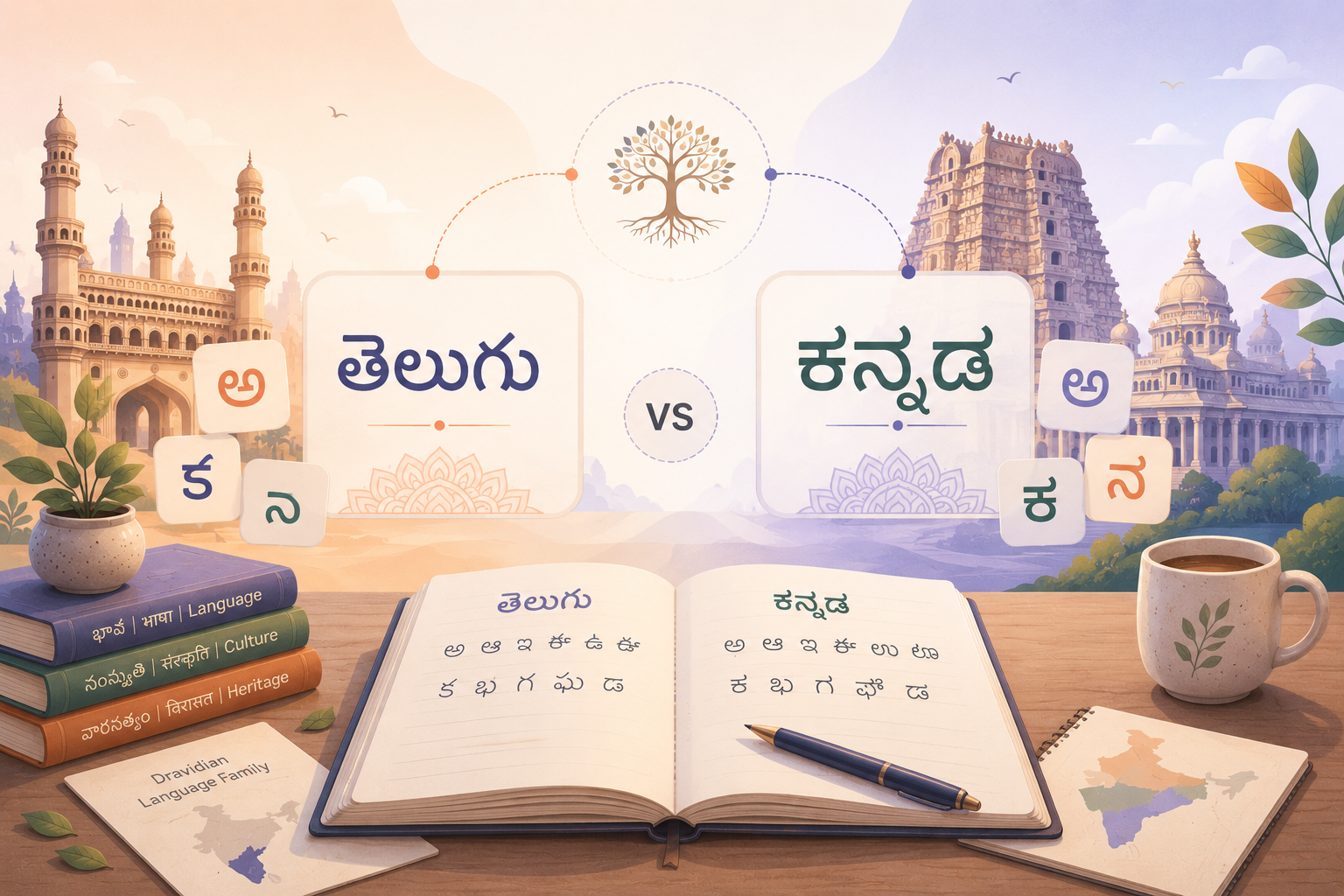
Telugu and Kannada are two of India's most spoken languages, both belonging to the Dravidian language family. Telugu dominates Andhra Pradesh and Telangana, while Kannada is the heartbeat of Karnataka. Together, they represent over 130 million native speakers.
If you're in Hyderabad or Bengaluru — two of India's biggest tech hubs — you've probably wondered how these languages compare, whether knowing one helps with the other, and which one to learn. This guide covers everything.
Origins: Siblings, Not Twins
Telugu and Kannada both descend from Proto-Dravidian, the ancient ancestor of all Dravidian languages. They belong to the South-Central and Southern branches of the Dravidian family respectively, making them related but not as close as many people assume.
Think of it like Spanish and Portuguese — clearly related, sharing vocabulary and structure, but distinct enough that speakers of one can't automatically understand the other.
| Feature | Telugu | Kannada |
|---|---|---|
| Language Family | Dravidian (South-Central branch) | Dravidian (Southern branch) |
| Native Speakers | ~85 million | ~45 million |
| Official In | Andhra Pradesh, Telangana | Karnataka |
| Classical Language Status | Yes (granted 2008) | Yes (granted 2008) |
| Oldest Inscriptions | ~575 CE (Kalamalla inscription) | ~450 CE (Halmidi inscription) |
Both languages received classical language status from the Indian government in the same year (2008), reflecting their ancient literary traditions. Kannada's oldest known inscription predates Telugu's by about a century, but both have rich histories spanning over 1,500 years.
Script: Similar Roots, Different Looks
Both Telugu and Kannada scripts evolved from the ancient Kadamba-Chalukya script, which means they share a common ancestor. In fact, until about the 13th-14th century, the two scripts were virtually identical and are sometimes referred to collectively as the "Telugu-Kannada script" by historians.
Over centuries, they diverged into distinct scripts, but if you look closely, you can still see family resemblances in many letters.
Telugu script has a rounded, flowing appearance with 16 vowels, 36 consonants, and a large number of conjunct characters. Telugu text is distinctive for its curvilinear shapes and the small hooks and curves on many letters.
Example: నమస్కారం, మీరు ఎలా ఉన్నారు? (Namaskaram, meeru ela unnaru? — Hello, how are you?)
Kannada script also has a rounded look with 14 vowels, 34 consonants, and its own set of conjuncts. Kannada letters tend to have more pronounced circular elements and a characteristic "headstroke" on many characters.
Example: ನಮಸ್ಕಾರ, ನೀವು ಹೇಗಿದ್ದೀರಿ? (Namaskara, neevu hegiddiri? — Hello, how are you?)
An interesting consequence of their shared script history: someone who learns Telugu script will find Kannada script easier to pick up (and vice versa) compared to learning Devanagari or Tamil script from scratch.
Grammar: More Similar Than Different
This is where Telugu and Kannada show their family resemblance most clearly. Both share several key grammatical features:
Word Order
Both follow SOV (Subject-Object-Verb) order:
- Telugu: నేను అన్నం తింటాను (Nenu annam tintaanu) — I rice eat
- Kannada: ನಾನು ಅನ್ನ ತಿನ್ನುತ್ತೇನೆ (Naanu anna tinnuttene) — I rice eat
Agglutination
Both are agglutinative, meaning they build complex words by adding suffixes. A single word can express what English needs an entire phrase for:
- Telugu: రాయించుకోలేకపోతున్నాను (raayinchukolekapotunnaanu) — "I am unable to get [someone] to write [for me]"
- Kannada: ಬರೆಸಿಕೊಳ್ಳಲಾಗುತ್ತಿಲ್ಲ (baresikollalaaguttilla) — same meaning, similarly agglutinated
Gender System
Both languages use a three-gender system:
- Masculine (male humans and gods)
- Feminine (female humans and goddesses)
- Neuter (everything else — objects, animals, concepts)
This is different from Hindi's two-gender system and is generally considered more intuitive for learners because the gender of a noun usually follows logical rules rather than arbitrary assignment.
Key Grammatical Differences
| Feature | Telugu | Kannada |
|---|---|---|
| Plurals | Suffix -లు (-lu): పుస్తకాలు (pustakalu — books) | Suffix -ಗಳು (-galu): ಪುಸ್ತಕಗಳು (pustakagalu — books) |
| Negative verbs | రాను (raanu — I won't come) | ಬರುವುದಿಲ್ಲ (baruvudilla — I won't come) |
| Question marker | -ా (-aa): వచ్చారా? (vacchaara? — Did you come?) | -ಆ (-aa) or -ಎ (-e): ಬಂದಿರಾ? (bandiraa? — Did you come?) |
| Verb tense markers | -తున్న- (-tunna-) for present continuous | -ುತ್ತಿ- (-utti-) for present continuous |
Vocabulary: Shared Roots and Divergences
Telugu and Kannada share a significant amount of vocabulary due to their common Dravidian origin. Many everyday words are recognizably similar:
| English | Telugu | Kannada | Similar? |
|---|---|---|---|
| Water | నీళ్ళు (neellu) | ನೀರು (neeru) | Yes — same root |
| House | ఇల్లు (illu) | ಮನೆ (mane) | No — different words |
| Food/Rice | అన్నం (annam) | ಅನ್ನ (anna) | Yes — nearly identical |
| Eye | కన్ను (kannu) | ಕಣ್ಣು (kannu) | Yes — identical |
| Hand | చేయి (cheyi) | ಕೈ (kai) | Somewhat — same root |
| Come | రా (raa) | ಬಾ (baa) | No — different roots |
| Go | వెళ్ళు (vellu) | ಹೋಗು (hogu) | No — different roots |
| Big | పెద్ద (pedda) | ದೊಡ್ಡ (dodda) | Somewhat — related |
| Fire | నిప్పు (nippu) | ಬೆಂಕಿ (benki) | No — different roots |
| Mother | అమ్మ (amma) | ಅಮ್ಮ (amma) | Yes — identical |
Roughly 30-40% of core vocabulary is recognizably similar between the two languages. However, Telugu has absorbed more Sanskrit vocabulary over the centuries (especially in formal and literary registers), while Kannada has retained more native Dravidian words in everyday speech.
Both languages have also borrowed from other sources: Telugu from Urdu/Persian (especially in Hyderabad's Deccani dialect), and Kannada from Marathi and Konkani in border regions.
Pronunciation: The Sound of Each Language
Telugu and Kannada sound different to the trained ear, even though they share many phonological features:
Telugu is famously melodic. It earned the nickname "Italian of the East" because nearly every word ends in a vowel sound (typically -u, -i, or -a). This gives Telugu a flowing, musical quality. Examples: పుస్తకము (pustakamu), బడి (badi), విద్యార్థి (vidyarthi).
Kannada has a slightly harder edge in comparison. While it also has vowel endings, Kannada includes more consonant-heavy clusters and a distinctive rhythm. The "ha" (ಹ) sound appears frequently and gives Kannada a characteristic cadence. Examples: ಹೊಸ (hosa — new), ಹೇಗೆ (hege — how), ಹೋಗು (hogu — go).
Both languages have retroflex consonants (sounds made by curling the tongue back) that don't exist in European languages and can be challenging for new learners.
Cultural Significance
Telugu Culture
Telugu culture is deeply connected to its film industry — Tollywood — which is the largest film industry in India by number of films produced, surpassing even Bollywood. The global success of films like Baahubali and RRR brought Telugu cinema to international attention. Telugu classical dance (Kuchipudi), music (Carnatic tradition), and cuisine (biryani from Hyderabad, Andhra's famously spicy food) are all integral to Telugu identity.
Kannada Culture
Karnataka's cultural identity is rich and multifaceted. Sandalwood (the Kannada film industry) has produced critically acclaimed cinema. Karnataka is home to three UNESCO World Heritage Sites — Hampi, Pattadakal, and the Western Ghats. Classical arts like Yakshagana theater, Mysore painting, and Carnatic music thrive alongside Bengaluru's modern tech culture. The state celebrates Rajyotsava (Karnataka Formation Day) with immense pride every November 1st.
Does Knowing One Help Learn the Other?
Yes, significantly. If you already speak Telugu or Kannada, learning the other is considerably easier than starting from scratch with an unrelated language:
- Grammar transfer: The SOV word order, agglutinative structure, postpositions, and gender system are nearly identical in concept.
- Shared vocabulary: 30-40% of common words are recognizable, giving you a significant head start.
- Script similarity: The scripts share a common ancestor, so many letter forms look familiar.
- Cultural context: Both are South Indian Dravidian cultures with shared cultural references, festivals, and food traditions.
Estimate: A Telugu speaker learning Kannada (or vice versa) can reach conversational proficiency in roughly half the time it would take a Hindi or English speaker.
Which One Should You Learn?
- Learn Telugu if: You're moving to Hyderabad, working in Andhra Pradesh or Telangana, love Tollywood, want to access the largest Dravidian-speaking population, or enjoy biryani so much you want to order it in the original language.
- Learn Kannada if: You're in Bengaluru (whether for tech, startups, or living), working in Karnataka, want to explore Hampi and Coorg like a local, or want to connect with Karnataka's unique blend of ancient culture and modern innovation.
- Learn both if: You want to unlock most of South India. Telugu + Kannada covers two states and four major cities (Hyderabad, Visakhapatnam, Bengaluru, Mysuru). Since knowing one makes the other significantly easier, this is a realistic and rewarding goal.
Learn Telugu and Kannada on Indilingo
Whether you choose Telugu, Kannada, or both, Indilingo makes learning intuitive. Our AI-powered platform lets you learn from your mother tongue — a Hindi speaker learning Kannada gets the entire experience in Hindi, and a Tamil speaker learning Telugu learns through Tamil.
With AI conversation practice, pronunciation feedback, interactive quizzes, and culturally rich content, you'll build real fluency for navigating Hyderabad's Old City or Bengaluru's Koramangala with confidence.
Start learning for free.
Download Indilingo on the Google Play Store and take the first step today.
Follow us on Instagram, X (Twitter), and LinkedIn for daily language insights.
Loved the Blog?
Take your language learning journey a step further.
Explore Indilingo - beautifully designed, easy to use, and built for Indian languages.