Tamil vs Malayalam: Key Differences and Similarities
Author: Jay Gala | Date: May 20, 2026
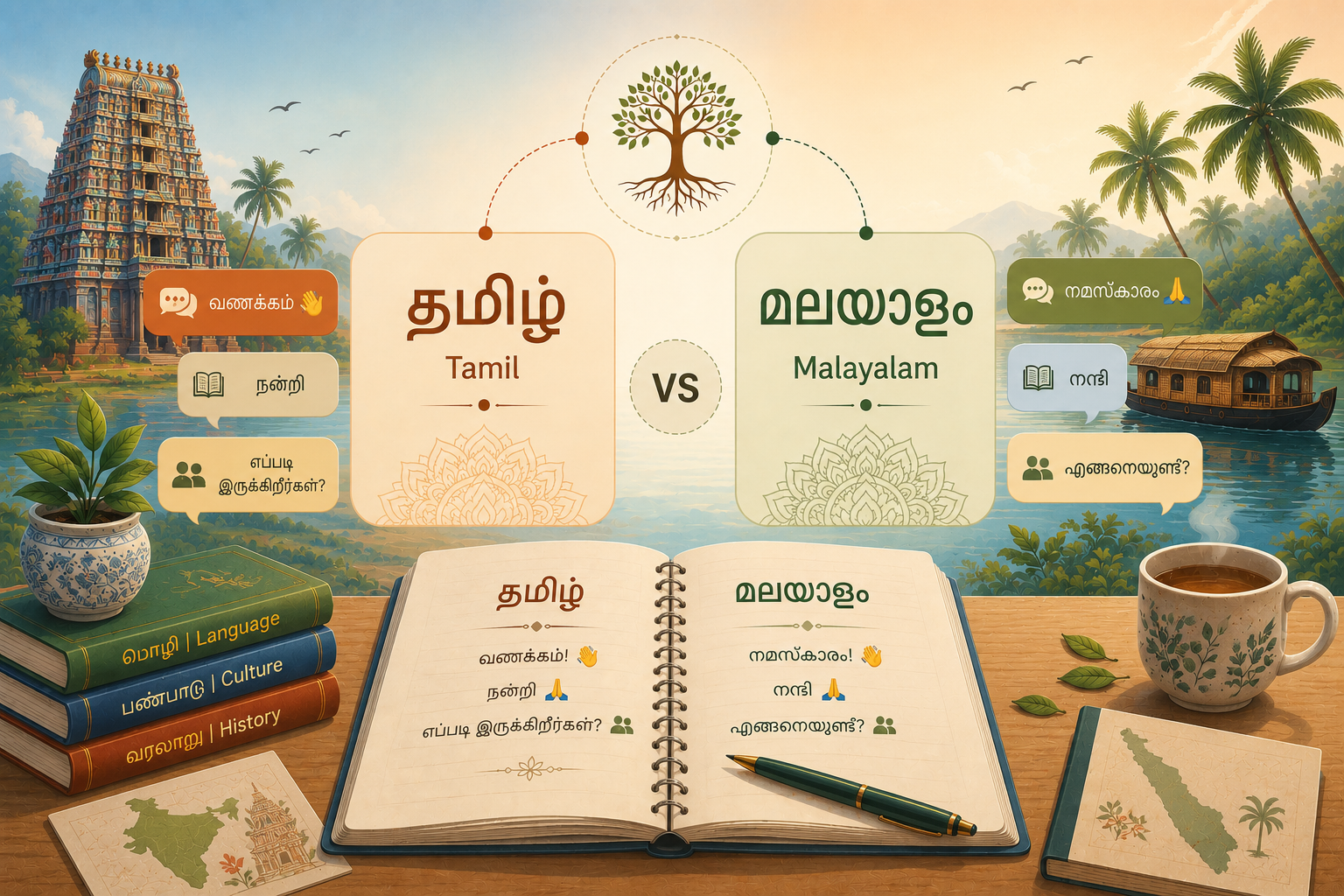
Tamil and Malayalam are the most closely related pair among India's major languages. Malayalam literally evolved from Tamil — splitting off as a distinct language between the 9th and 13th centuries CE. Today, they're spoken by a combined 120 million people across Tamil Nadu, Kerala, and diaspora communities worldwide.
If you speak one, how much of the other can you understand? Where exactly did they diverge? And which one should you learn? Let's break it all down.
Origins: Mother and Daughter
Unlike Hindi and Bengali (which are cousins descended from a common ancestor), Tamil and Malayalam have a direct parent-child relationship.
Tamil is one of the oldest living languages in the world. The earliest Tamil inscriptions date to the 3rd century BCE, and the Sangam literature (300 BCE – 300 CE) represents one of humanity's oldest literary traditions. Tamil was the first Indian language granted Classical Language status (2004).
Malayalam evolved from Old Tamil (also called Tamil-Malayalam or Proto-Tamil-Malayalam) through a gradual process of divergence that began around the 9th century CE and was clearly established by the 13th century. The split happened as the western coastal region (modern Kerala) developed distinct phonological and grammatical features, influenced by contact with Sanskrit, Arabic, and Portuguese traders.
| Feature | Tamil | Malayalam |
|---|---|---|
| Language Family | Dravidian (Southern branch) | Dravidian (Southern branch) |
| Native Speakers | ~80 million | ~38 million |
| Oldest Literature | ~3rd century BCE | ~9th century CE |
| Classical Status | Yes (2004 — first language recognized) | Yes (2013) |
| Official In | Tamil Nadu, Puducherry, Sri Lanka, Singapore | Kerala, Lakshadweep |
| Relationship | Parent language | Evolved from Old Tamil |
This parent-child relationship means Tamil and Malayalam share more vocabulary, grammar, and structural features than any other pair of major Indian languages. A Tamil speaker in Kerala or a Malayalam speaker in Tamil Nadu can often follow the gist of conversations, especially in rural areas where the languages have diverged less.
Script: Shared Ancestor, Very Different Today
Both scripts descended from the ancient Tamil-Brahmi and later Vatteluttu scripts, but they've diverged dramatically in appearance.
Tamil script is visually distinctive with its angular, geometric forms. It's notably compact — Tamil uses just 12 vowels, 18 consonants, and 1 special character (ஃ), making it one of the most streamlined scripts in India. Tamil script deliberately avoids representing aspirated consonants and certain Sanskrit sounds, reflecting the Tamil purist tradition.
Example: வணக்கம், நீங்கள் எப்படி இருக்கிறீர்கள்? (Vanakkam, neengal eppadi irukkireergal? — Hello, how are you?)
Malayalam script is famously rounded and curvilinear — often called one of the most beautiful scripts in the world. It has more characters than Tamil (15 vowels, 36 consonants) because it adopted additional letters to represent Sanskrit sounds that Tamil script chose not to include. This makes Malayalam script capable of writing Sanskrit words in their original form.
Example: നമസ്കാരം, നിങ്ങൾക്ക് സുഖമാണോ? (Namaskaram, ningalkku sukhamaano? — Hello, are you well?)
Despite their shared origin, the two scripts look completely different today. A Tamil reader cannot read Malayalam and vice versa without learning the other script.
Vocabulary: The Deepest Connection
This is where the mother-daughter relationship is most visible. Tamil and Malayalam share an enormous amount of core vocabulary:
| English | Tamil | Malayalam | Similar? |
|---|---|---|---|
| Water | தண்ணீர் (thanneer) | വെള്ളം (vellam) / തണ്ണീർ (thanneer) | Partial — both forms exist in Malayalam |
| House | வீடு (veedu) | വീട് (veedu) | Yes — nearly identical |
| Eye | கண் (kan) | കണ്ണ് (kannu) | Yes — same root |
| Come | வா (vaa) | വാ (vaa) | Yes — identical |
| Good | நல்ல (nalla) | നല്ല (nalla) | Yes — identical |
| Eat | சாப்பிடு (saappidu) | കഴിക്കുക (kazhikkuka) | No — different words |
| Rain | மழை (mazhai) | മഴ (mazha) | Yes — same root |
| Flower | பூ (poo) | പൂ (poo) | Yes — identical |
| Mother | அம்மா (amma) | അമ്മ (amma) | Yes — identical |
| See | பார் (paar) | കാണുക (kaanuka) | No — different words |
| Tree | மரம் (maram) | മരം (maram) | Yes — identical |
| Fish | மீன் (meen) | മീൻ (meen) | Yes — identical |
Estimates suggest 60-70% of core vocabulary is shared or recognizably related — far higher than any other pair of major Indian languages. Many words are completely identical in both languages, differing only in script.
The Sanskrit Factor
The biggest vocabulary divergence comes from Sanskrit borrowings. Malayalam has absorbed far more Sanskrit vocabulary than Tamil, especially for formal, literary, and technical terms. This is partly historical (Kerala's Brahminical traditions embraced Sanskrit) and partly because Malayalam script can represent Sanskrit sounds that Tamil script cannot.
Example: The word for "beautiful":
- Tamil: அழகான (azhagana) — native Dravidian root
- Malayalam: സുന്ദരമായ (sundaramaaya) — Sanskrit-derived
Tamil's language purism movement (Thanith Thamizh Iyakkam) actively replaced Sanskrit borrowings with native Tamil words, while Malayalam took the opposite approach, freely incorporating Sanskrit. This means formal Malayalam often sounds more "Sanskritic" than formal Tamil.
Grammar: Same Blueprint, Different Details
What They Share
- SOV word order: Both place the verb at the end
- Agglutination: Both build complex words by stacking suffixes
- Postpositions: Both use postpositions instead of prepositions
- No grammatical gender for objects: Both use rational gender (masculine/feminine for people, neuter for things)
- Case system: Both mark nouns with case suffixes to show grammatical role
Key Grammatical Differences
| Feature | Tamil | Malayalam |
|---|---|---|
| Verb ending style | Person/number/gender suffixed to verb: சாப்பிடுகிறேன் (saappidugiren — I eat) | Infinitive-style verb forms common: കഴിക്കുന്നു (kazhikkunnu — eating/eats) |
| Negative verbs | Has distinct negative verb forms: போகமாட்டேன் (pogamatten — I won't go) | Uses "illa" (ഇല്ല) as negation particle: പോകില്ല (pokilla — won't go) |
| Plural formation | -கள் (-gal): புத்தகங்கள் (puthagangal — books) | -കൾ (-kal): പുസ്തകങ്ങൾ (pusthakangal — books) |
| Formality levels | Multiple levels with distinct pronouns and verb forms | Similar system but with some different pronoun forms |
| Sanskrit compounds | Avoided in modern usage | Freely used, especially in formal writing |
Pronunciation: The Telltale Differences
Even though the languages share so much vocabulary, they sound quite different when spoken. A practiced ear can instantly tell Tamil from Malayalam.
The "Zha" Sound
Both Tamil and Malayalam have the unique retroflex approximant "zha" (ழ in Tamil, ഴ in Malayalam) — a sound that doesn't exist in any other major Indian language. This is the sound in "Tamizh" (the correct pronunciation of "Tamil") and "Kerala" (originally "Keralam" with this sound in older forms).
Consonant Differences
Malayalam has more consonant sounds than Tamil. Because Malayalam adopted Sanskrit consonants, it distinguishes between aspirated and unaspirated stops (ka vs kha, ga vs gha) that Tamil does not. Tamil uses the same letter for ka/ga/ha depending on position — Malayalam has separate letters for each.
This means a Tamil speaker learning Malayalam needs to learn new consonant distinctions, while a Malayalam speaker learning Tamil needs to "merge" some distinctions they're used to making.
Rhythm and Intonation
Tamil tends to sound crisper and more staccato, with clearer syllable boundaries. The language has a rhythmic, almost percussive quality.
Malayalam is often described as faster and more flowing, with syllables blending into each other more smoothly. Malayalam speakers are stereotypically known for speaking quickly — there's even a good-natured joke that Malayalam sounds like "a tape on fast-forward" to non-speakers.
Cultural Significance
Tamil Culture
Tamil identity is deeply intertwined with the language. The Tamil pride movement (Thamizh Pattru) has shaped the politics, literature, and social fabric of Tamil Nadu for over a century. Tamil has one of the world's oldest continuous literary traditions, and Tamil speakers are passionate about preserving the language's purity.
Kollywood (Tamil cinema) is India's second-largest film industry and has produced globally acclaimed films. Tamil music, from Carnatic classical to Ilaiyaraaja and A.R. Rahman, is celebrated worldwide. The language's influence extends beyond India to Sri Lanka, Singapore, Malaysia, and large diaspora communities.
Malayalam Culture
Kerala, despite being one of India's smaller states, has an outsized cultural impact. Kerala's literacy rate (96%+) is India's highest, and Malayalam literature is among the most vibrant in the country, with writers like Vaikom Muhammad Basheer, M.T. Vasudevan Nair, and Arundhati Roy (who writes in English but grew up in Malayalam).
Malayalam cinema has experienced a global renaissance in recent years, with films like Drishyam, Premam, and Jallikattu gaining international recognition. Keralites are also known for their massive presence in the Gulf countries, creating a unique Malayalam-speaking diaspora that blends Kerala culture with Middle Eastern influences.
Kerala's unique traditions — Kathakali dance-drama, Ayurveda, Onam festival, and the famous backwater houseboat culture — are all deeply connected to the Malayalam language.
Mutual Intelligibility: How Much Can They Understand?
This is the question everyone asks, and the honest answer is: it depends.
- Formal/literary language: Lower mutual intelligibility, because formal Tamil avoids Sanskrit while formal Malayalam embraces it. A literary Malayalam passage might be incomprehensible to a Tamil speaker.
- Colloquial/everyday speech: Higher mutual intelligibility, especially for basic topics. Everyday vocabulary overlaps significantly. A Tamil speaker in Kerala can often follow the gist of casual conversation.
- Border dialects: Highest mutual intelligibility. Tamil spoken in districts bordering Kerala and Malayalam spoken near the Tamil Nadu border often blend features of both languages.
- Realistic estimate: A Tamil speaker hearing Malayalam for the first time can understand roughly 30-40% of casual speech — enough to get the general topic but not enough for detailed comprehension.
Which One Should You Learn?
- Learn Tamil if: You're in Tamil Nadu or Chennai, you want to access one of the world's oldest literary traditions, you love Tamil cinema, you have Tamil-speaking family, or you plan to visit Sri Lanka or Singapore.
- Learn Malayalam if: You're heading to Kerala (for work, tourism, or Ayurveda), you love Malayalam cinema's recent golden age, you have Malayali family or friends, or you're interested in the Gulf diaspora community.
- Learn both if: This is the most natural two-language combo in India. Once you know one, the other becomes dramatically easier. Tamil → Malayalam or Malayalam → Tamil is the shortest bridge between any two major Indian languages.
Learn Tamil and Malayalam on Indilingo
Whether you start with Tamil or Malayalam, Indilingo's AI-powered platform makes the journey smooth. Learn from your mother tongue — Hindi, Telugu, Kannada, or any other language. Our app adapts entirely to you.
With pronunciation feedback (essential for mastering the unique "zha" sound), AI conversation practice, and culturally rich lessons, you'll build real fluency for navigating Chennai's streets or Kerala's backwaters.
Start learning for free.
Download Indilingo on the Google Play Store.
Follow us on Instagram, X (Twitter), and LinkedIn for daily language insights.
Loved the Blog?
Take your language learning journey a step further.
Explore Indilingo - beautifully designed, easy to use, and built for Indian languages.