The Indian Language Family Tree: How India's 22 Languages Are Connected
Author: Jay Gala | Date: May 20, 2026
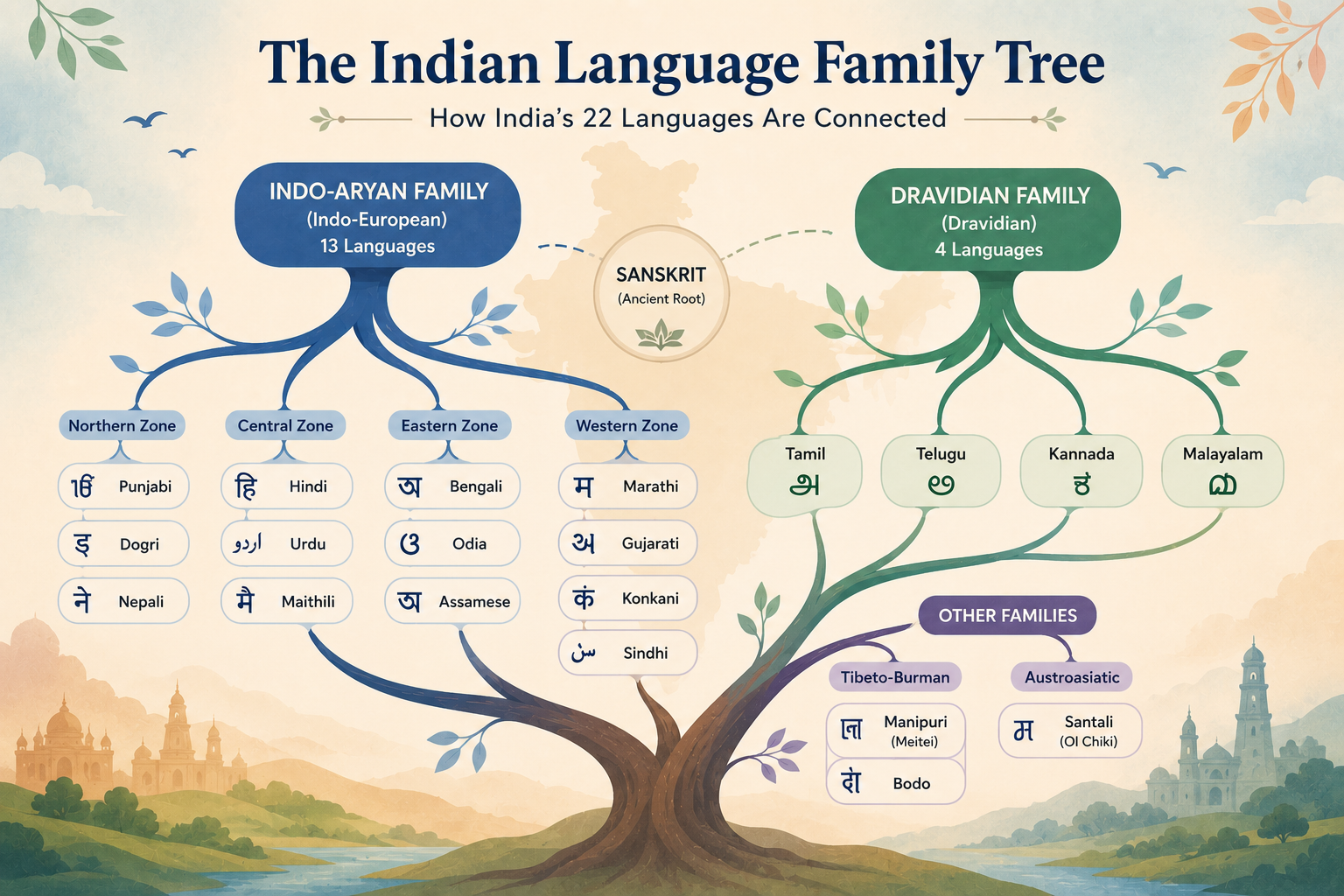
India's Constitution recognizes 22 scheduled languages. But how are they related? Are Hindi and Bengali cousins? Is Tamil connected to Telugu? Where does Sanskrit fit in? And why do some Indian languages sound completely different from each other while sharing a country?
This guide maps out the family tree of India's official languages — who's related to whom, what they share, and why understanding these connections makes learning any Indian language easier.
Two Great Families
India's 22 scheduled languages come from primarily two language families, plus a few others:
The Indo-Aryan Family (North India) — 13 languages
The Indo-Aryan languages descended from Sanskrit through intermediate stages called Prakrit and Apabhramsha. They belong to the larger Indo-European family, making them distant relatives of English, French, Spanish, Persian, and Russian.
The family members: Hindi, Bengali, Marathi, Gujarati, Punjabi, Odia, Assamese, Urdu, Sindhi, Nepali, Maithili, Konkani, Dogri
Think of Sanskrit as the great-grandparent. Just as Latin gave rise to Spanish, French, Italian, and Portuguese, Sanskrit's descendants evolved into the modern Indo-Aryan languages over 2,000+ years. They didn't evolve directly from classical Sanskrit — they came through Prakrits (vernacular languages that existed alongside Sanskrit), which then evolved into the modern languages.
The Dravidian Family (South India) — 4 languages
The Dravidian languages have no established connection to Indo-European languages. They come from a separate ancestor called Proto-Dravidian, whose origins are debated but predate the arrival of Indo-Aryan languages in South Asia.
The family members: Tamil, Telugu, Kannada, Malayalam
Tamil is the oldest attested Dravidian language (inscriptions from 3rd century BCE), and Malayalam actually split from Tamil as recently as the 9th-13th century CE — making Tamil and Malayalam the closest pair in the Dravidian family.
Other Families
Two scheduled languages come from outside these two major families:
- Manipuri (Meitei) — belongs to the Tibeto-Burman family, related to languages spoken in Myanmar, Tibet, and Northeast India
- Santali — belongs to the Austroasiatic (Munda) family, related to languages in Southeast Asia
- Bodo — belongs to the Tibeto-Burman family
These languages represent India's deeper linguistic diversity, predating both Indo-Aryan and Dravidian dominance in their regions.
The Indo-Aryan Branch: How Hindi's Siblings Are Connected
The 13 Indo-Aryan languages can be grouped by sub-branch:
Central Zone (Hindi Belt)
Hindi, Urdu, Maithili
Hindi and Urdu are essentially the same spoken language with different scripts (Devanagari vs Nastaliq) and different literary/formal vocabulary (Sanskrit-derived vs Persian/Arabic-derived). A Hindi speaker and an Urdu speaker can have a perfectly natural conversation. They diverge mainly in writing and formal registers.
Maithili, spoken in Bihar, was historically considered a Hindi dialect but received recognition as a separate language in 2003. It has its own literary tradition dating back to the 14th century poet Vidyapati.
Eastern Zone
Bengali, Odia, Assamese
These three are the closest relatives among India's scheduled languages. Bengali and Assamese even share a script (with minor differences). A Bengali speaker can often understand slow spoken Assamese and vice versa. Odia, while more distinct, shares significant vocabulary with both.
| English | Bengali | Odia | Assamese |
|---|---|---|---|
| Water | জল (jol) | ଜଳ (jala) | পানী (pani) |
| One | এক (ek) | ଏକ (eka) | এক (ek) |
| Hand | হাত (haat) | ହାତ (haata) | হাত (haat) |
| Come | আসা (aasha) | ଆସିବା (aasibaa) | অহা (oha) |
Western Zone
Marathi, Gujarati, Konkani, Sindhi
Marathi and Konkani are very closely related — Konkani speakers often understand Marathi with little difficulty. Gujarati shares its western zone placement and evolved alongside Marathi, though they've diverged significantly. Sindhi, originally from present-day Pakistan's Sindh province, is the most distinct member.
An interesting connection: Marathi uses Devanagari script (same as Hindi), Gujarati uses a modified Devanagari without the headline, and Konkani uses multiple scripts depending on the region (Devanagari, Kannada, or Roman).
Northern Zone
Punjabi, Dogri, Nepali
Punjabi is spoken across Indian and Pakistani Punjab and is the language of Sikh scripture (Guru Granth Sahib is in Gurmukhi script). Dogri, spoken in Jammu, was recognized as a scheduled language in 2003. Nepali, while the national language of Nepal, is also spoken widely in Sikkim, Darjeeling, and other parts of Northeast India.
The Dravidian Branch: How South India's Languages Are Connected
The four Dravidian scheduled languages have a clear hierarchy of closeness:
The Closest Pair: Tamil and Malayalam
Malayalam is sometimes called "Tamil's daughter." It evolved from Old Tamil between the 9th-13th century CE, making the split relatively recent in linguistic terms. Tamil and Malayalam share substantial vocabulary, and a Tamil speaker can often understand simple Malayalam (and vice versa) with some effort.
| English | Tamil | Malayalam |
|---|---|---|
| Water | தண்ணீர் (thanneer) | വെള്ളം (vellam) |
| Come | வா (vaa) | വാ (vaa) |
| House | வீடு (veedu) | വീട് (veedu) |
| Good | நல்ல (nalla) | നല്ല (nalla) |
| Eye | கண் (kan) | കണ്ണ് (kannu) |
The Second Pair: Telugu and Kannada
Telugu and Kannada shared a common script until the 13th-14th century and have significant vocabulary overlap (~30-40% of core words). They're not as close as Tamil-Malayalam, but closer to each other than to Tamil or Malayalam.
Cross-Family Borrowing
While Dravidian languages are unrelated to Indo-Aryan languages, centuries of contact have created significant vocabulary overlap. All four Dravidian languages have borrowed Sanskrit words, and Indo-Aryan languages (especially Marathi, which borders Karnataka) have absorbed Dravidian features.
Some linguists believe that Dravidian languages influenced Sanskrit itself — features like retroflex consonants (ट, ड, ण) in Sanskrit may have come from Dravidian contact, since Proto-Indo-European didn't have these sounds.
Sanskrit: The Great-Grandparent (Sort Of)
Sanskrit holds a unique position in India's language family tree. It's not a scheduled language in the same way as the others (it has very few native speakers), but it's:
- The direct ancestor of all Indo-Aryan scheduled languages through Prakrit
- A major vocabulary donor to Dravidian languages — Telugu and Kannada in particular have absorbed thousands of Sanskrit words
- The language of India's classical texts — Vedas, Upanishads, Mahabharata, Ramayana, Yoga Sutras
- A recognized scheduled language and a classical language of India
Sanskrit's relationship to Hindi is similar to Latin's relationship to Italian — the ancestor is recognizable in the descendant, but they're not mutually intelligible. A Hindi speaker cannot understand spoken Sanskrit without study, just as an Italian speaker cannot understand Latin.
What This Means for Language Learners
Understanding the family tree has practical implications for your learning strategy:
If you know Hindi...
- Easiest next languages: Urdu (essentially the same spoken language), Nepali (very high mutual intelligibility), Marathi (same script + shared vocabulary), Gujarati (similar script + shared grammar)
- Moderate difficulty: Bengali, Punjabi, Odia (different scripts but related grammar and vocabulary)
- Starting fresh: Tamil, Telugu, Kannada, Malayalam (different family entirely — treat as new languages)
If you know Tamil...
- Easiest next language: Malayalam (closest relative, significant mutual intelligibility)
- Moderate difficulty: Kannada, Telugu (same family, shared features, some vocabulary overlap)
- Starting fresh: Hindi, Bengali, Marathi, etc. (different family — treat as new languages)
If you know Telugu or Kannada...
- Easiest next language: The other one (Telugu ↔ Kannada have the most overlap after Tamil ↔ Malayalam)
- Moderate difficulty: Tamil, Malayalam (same family but more distant)
- Also moderate: Hindi, Marathi (different family but significant Sanskrit vocabulary overlap, especially with Telugu)
The Strategic Approach
The most efficient way to learn multiple Indian languages is to work within a family first, then jump across:
- Start with one language from either family (Hindi or Tamil are the most common starting points)
- Learn a close relative next (Hindi → Marathi, or Tamil → Malayalam)
- Then jump to the other family (this is the hardest step but also the most rewarding)
- Within the new family, subsequent languages come much faster
India's Linguistic Diversity Is Its Strength
Having 22 scheduled languages isn't a problem to solve — it's a treasure to protect. Each language represents a unique way of thinking, a distinct literary tradition, and a living connection to centuries of culture and history.
The fact that an Indian can grow up speaking Kannada at home, learning Hindi in school, studying English for work, and picking up Tamil from neighbors — that's not confusion. That's a cognitive and cultural superpower that most countries can only dream of.
Explore India's Languages with Indilingo
Whether you want to learn a language from your own family branch or jump to an entirely new one, Indilingo makes it possible. Our app covers languages across both the Indo-Aryan and Dravidian families, and lets you learn from whichever language you already speak.
Start mapping your own path through India's incredible language family tree.
Download Indilingo for free on the Google Play Store.
Follow us on Instagram, X (Twitter), and LinkedIn for language facts, learning tips, and cultural insights.
Loved the Blog?
Take your language learning journey a step further.
Explore Indilingo - beautifully designed, easy to use, and built for Indian languages.