How to Say Thank You in 15 Indian Languages
Author: Jay Gala | Date: May 20, 2026
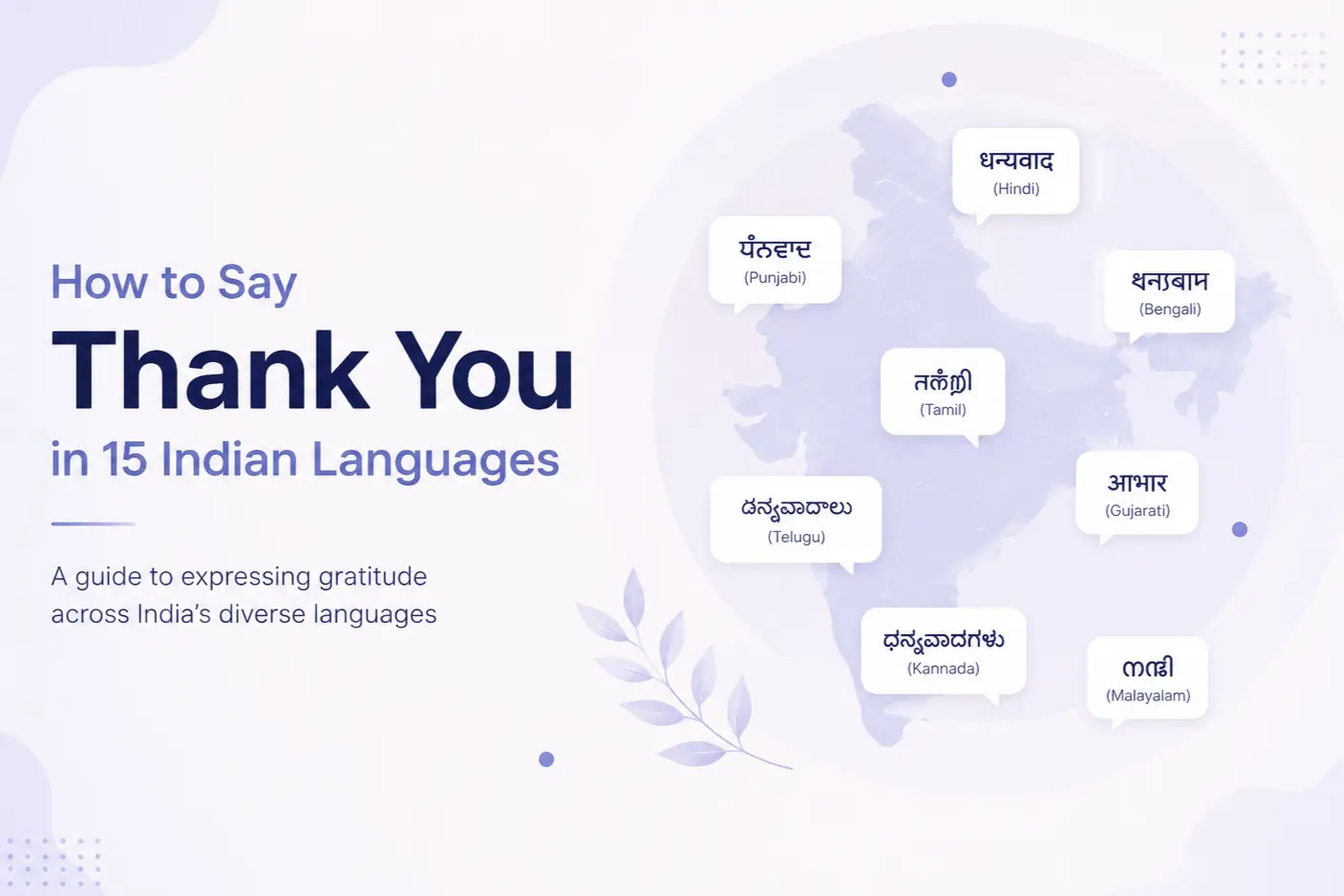
India is home to over 1.4 billion people speaking hundreds of languages across 28 states and 8 union territories. Saying "thank you" in someone's native language is one of the simplest yet most powerful ways to show respect, build connection, and break cultural barriers. Whether you're traveling across India, working with colleagues from different states, or reconnecting with your heritage, knowing how to express gratitude in multiple Indian languages goes a long way.
Here's your complete guide to saying thank you in 15 major Indian languages, with pronunciation tips, cultural context, and the script for each.
1. Hindi — धन्यवाद (Dhanyavaad)
Script: धन्यवाद
Pronunciation: dhun-yuh-vaad
Usage: Hindi is spoken by over 600 million people across India, making it the most widely spoken language in the country. "Dhanyavaad" is the formal way to say thank you. In casual conversation, many Hindi speakers simply say "Shukriya" (शुक्रिया), which comes from Urdu and is equally common in everyday interactions. You'll hear both used interchangeably across North India.
2. Tamil — நன்றி (Nandri)
Script: நன்றி
Pronunciation: nun-dree
Usage: Tamil is one of the oldest living languages in the world, with a literary tradition spanning over 2,000 years. "Nandri" is used in both formal and informal settings across Tamil Nadu and among the Tamil diaspora in Sri Lanka, Singapore, and Malaysia. It carries a deep sense of genuine gratitude.
3. Telugu — ధన్యవాదాలు (Dhanyavaadaalu)
Script: ధన్యవాదాలు
Pronunciation: dhun-yuh-vaa-daa-lu
Usage: Telugu is the most spoken Dravidian language by native speakers and the official language of Andhra Pradesh and Telangana. The plural suffix "-lu" adds a respectful, polished tone. Telugu is sometimes called the "Italian of the East" because most words end in vowels, giving it a melodic quality.
4. Bengali — ধন্যবাদ (Dhonnobad)
Script: ধন্যবাদ
Pronunciation: dhon-no-baad
Usage: Bengali is the official language of West Bengal and Bangladesh. Known for its rich literary and poetic tradition (Rabindranath Tagore wrote in Bengali), "Dhonnobad" is used widely in formal contexts. In casual settings among friends and family, Bengalis often express gratitude through gestures and tone rather than explicit words.
5. Marathi — धन्यवाद (Dhanyavaad)
Script: धन्यवाद
Pronunciation: dhun-yuh-vaad
Usage: Marathi is the official language of Maharashtra and is spoken by over 83 million people. While "Dhanyavaad" is the standard formal expression, you'll also hear "Aabhari aahe" (आभारी आहे), meaning "I am grateful," in more heartfelt contexts. Marathi culture places great importance on respect and hospitality.
6. Kannada — ಧನ್ಯವಾದಗಳು (Dhanyavaadagalu)
Script: ಧನ್ಯವಾದಗಳು
Pronunciation: dhun-yuh-vaa-duh-guh-lu
Usage: Kannada is the official language of Karnataka and one of the oldest Dravidian languages with a rich inscriptional history. The suffix "-galu" makes it plural and respectful. If you're in Bangalore for work or study, using "Dhanyavaadagalu" with auto drivers, shopkeepers, or colleagues will instantly earn you goodwill.
7. Malayalam — നന്ദി (Nanni)
Script: നന്ദി
Pronunciation: nun-nee
Usage: Malayalam is spoken primarily in Kerala and Lakshadweep. Known for its unique circular script and high literacy rate (Kerala has India's highest), "Nanni" is a simple, warm expression of thanks. Kerala's culture of hospitality means you'll have plenty of opportunities to use it, from toddy shops to backwater houseboats.
8. Gujarati — આભાર (Aabhaar)
Script: આભાર
Pronunciation: aa-bhaar
Usage: Gujarati is the language of Gujarat, spoken by over 55 million people including large diaspora communities in the US, UK, and East Africa. "Aabhaar" conveys a deep sense of obligation and gratitude. Gujarati culture is famous for its warmth, hospitality, and the phrase "Kem cho?" (How are you?) that greets every visitor.
9. Punjabi — ਧੰਨਵਾਦ (Dhannvaad)
Script: ਧੰਨਵਾਦ (Gurmukhi)
Pronunciation: dhun-vaad
Usage: Punjabi is the language of Punjab and one of the most energetic, expressive languages in India. While "Dhannvaad" is the formal thank you, Punjabis are known for expressing gratitude through generous actions, whether it's an extra serving of food or going out of their way to help. "Shukriya" is also commonly used in casual settings.
10. Odia — ଧନ୍ୟବାଦ (Dhanyabaad)
Script: ଧନ୍ୟବାଦ
Pronunciation: dhun-yuh-baad
Usage: Odia is the official language of Odisha and is one of India's classical languages with a literary history going back over a thousand years. The rounded, curvilinear Odia script is distinctive and beautiful. "Dhanyabaad" is used in formal situations, while gratitude in Odia culture is often expressed through respectful gestures like touching elders' feet.
11. Assamese — ধন্যবাদ (Dhonyobad)
Script: ধন্যবাদ
Pronunciation: dhon-yo-baad
Usage: Assamese is the principal language of Assam in Northeast India. It shares its script with Bengali but has distinct pronunciation. "Dhonyobad" is used in formal and semi-formal contexts. Assamese culture, centered around the Bihu festival and tea gardens, values community and shared gratitude.
12. Urdu — شکریہ (Shukriya)
Script: شکریہ
Pronunciation: shuk-ree-yah
Usage: Urdu is known for its poetic elegance and is widely spoken across India and Pakistan. "Shukriya" is perhaps the most universally recognized way to say thank you across the Hindi-Urdu speaking world. Its Persian origins give it a lyrical quality. In more formal Urdu, you might also hear "Meherbaani" (مہربانی), meaning "kindness."
13. Sanskrit — धन्यवादः (Dhanyavaadah)
Script: धन्यवादः
Pronunciation: dhun-yuh-vaa-duh-ha
Usage: Sanskrit is the ancient language from which many modern Indian languages derive their vocabulary. While not widely spoken in daily conversation, it holds immense cultural and spiritual significance. "Dhanyavaadah" literally means "giving thanks" and is the root word that Hindi, Marathi, and many other Indian languages borrowed for their own versions of "thank you."
14. Konkani — देव बरें करूं (Dev Barein Karun)
Script: देव बरें करूं
Pronunciation: dev buh-rein kuh-roon
Usage: Konkani is spoken primarily in Goa, coastal Karnataka, and parts of Maharashtra. This unique expression literally translates to "May God do good to you," reflecting the deep spiritual thread in Konkani culture. It's a beautiful example of how gratitude and blessings are intertwined in Indian languages.
15. Maithili — धन्यवाद (Dhanyavaad)
Script: धन्यवाद
Pronunciation: dhun-yuh-vaad
Usage: Maithili is spoken predominantly in Bihar and parts of Nepal. It is one of India's 22 scheduled languages and has a rich literary tradition, including the works of Vidyapati. While the written form resembles Hindi, the spoken pronunciation and intonation have their own distinct flavor.
Why Saying Thank You in the Local Language Matters
In India, language is deeply tied to identity. When you say "Nandri" instead of just "Thank you" to a Tamil speaker, or "Dhanyavaadagalu" to someone from Karnataka, you're doing more than being polite. You're saying: I see you. I respect your culture. I made the effort.
This small gesture can:
- Break ice instantly with strangers in a new city
- Build trust with colleagues from different states
- Show respect to elders and in-laws in their mother tongue
- Make travel experiences across India richer and more authentic
- Help your children connect with their linguistic heritage
Start Learning Indian Languages Today
Saying thank you is just the beginning. If you want to go beyond basic phrases and actually hold conversations in Hindi, Tamil, Telugu, Kannada, Bengali, Marathi, and more, Indilingo makes it easy.
Our AI-powered app lets you learn any Indian language from your mother tongue, so you're never forced to learn through English. With interactive lessons, AI conversation practice, pronunciation feedback, and culturally rich content, you'll go from "Dhanyavaad" to full conversations faster than you think.
Ready to start your journey?
Download Indilingo for free on the Google Play Store and begin learning today.
Follow us on Instagram, X (Twitter), and LinkedIn for daily language tips and cultural insights.
Loved the Blog?
Take your language learning journey a step further.
Explore Indilingo - beautifully designed, easy to use, and built for Indian languages.