How to Learn Hindi in 30 Days: A Realistic Guide
Author: Jay Gala | Date: May 20, 2026
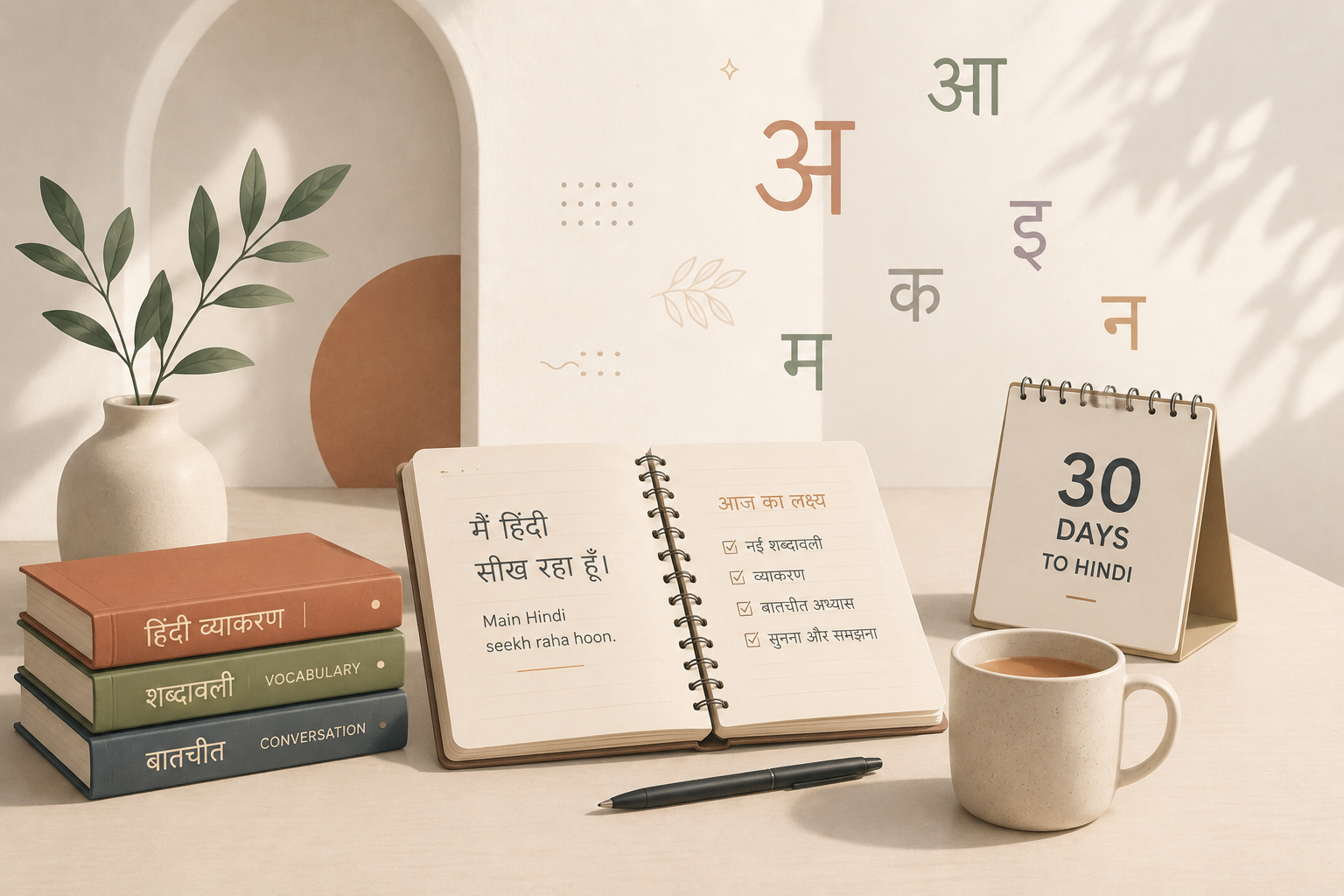
Can you learn Hindi in 30 days? Let's be honest: you won't become fluent in a month. But you can go from zero to having real, basic conversations — ordering food, introducing yourself, navigating cities, and chatting with colleagues — if you follow a structured plan and commit to 30-45 minutes a day.
This guide gives you a realistic, week-by-week roadmap. No fluff, no false promises. Just a practical plan built on how language acquisition actually works.
Before You Start: Set the Right Expectations
Here's what 30 days of focused Hindi study can realistically get you:
- You will be able to: Read Devanagari script, introduce yourself, order food, ask for directions, have simple conversations about daily life, understand common signs and menus, and follow slow spoken Hindi.
- You won't be able to: Watch a Bollywood movie without subtitles, read a Hindi newspaper fluently, debate politics, or pass for a native speaker.
That's a massive amount of progress for 30 days. Most people who "fail" at learning Hindi don't fail because Hindi is too hard — they fail because they expected fluency in a month and gave up when they didn't get it. Set realistic goals and you'll actually hit them.
Week 1: The Foundation (Days 1–7)
Goal: Read Devanagari + Learn 50 Core Words
The first week is about building the base everything else rests on. Resist the urge to skip ahead to conversations — this foundation work pays dividends for the entire month.
Days 1–3: Learn the Devanagari Script
This is the single most important thing you'll do. Many learners skip this and try to learn Hindi purely through romanization (writing Hindi in English letters). This is a mistake that will limit you forever.
Devanagari is actually easier than it looks:
- It's phonetic — every letter makes exactly one sound, always. Unlike English, there are no silent letters or irregular pronunciations.
- There are 11 vowels (अ, आ, इ, ई, उ, ऊ, ए, ऐ, ओ, औ, ऋ) and 33 consonants.
- Vowels attach to consonants as marks (called matras). For example: क (ka) + ी (ee matra) = की (kee).
- The letters are organized scientifically by where in your mouth you produce the sound — from the back of the throat to the lips.
Daily practice (Days 1-3):
- Spend 20 minutes learning 10-15 letters per day
- Write each letter 10 times by hand (yes, by hand — it builds muscle memory)
- Spend 10 minutes practicing reading simple words
- By Day 3, you should be able to slowly read any Hindi word, even if you don't know what it means
Days 4–7: Core Vocabulary + Basic Greetings
Now that you can read, start building your first 50 words. Focus on high-frequency words you'll actually use:
Greetings and basics:
| Hindi | Romanized | English |
|---|---|---|
| नमस्ते | Namaste | Hello |
| हाँ | Haan | Yes |
| नहीं | Nahin | No |
| धन्यवाद | Dhanyavaad | Thank you |
| माफ़ कीजिए | Maaf kijiye | Sorry / Excuse me |
| कृपया | Kripya | Please |
| अच्छा | Achha | Good / Okay |
Pronouns and question words:
| Hindi | Romanized | English |
|---|---|---|
| मैं | Main | I |
| आप | Aap | You (formal) |
| यह | Yeh | This |
| वह | Voh | That |
| क्या | Kya | What |
| कहाँ | Kahaan | Where |
| कब | Kab | When |
| कैसे | Kaise | How |
| कितना | Kitna | How much |
| क्यों | Kyon | Why |
Daily practice (Days 4-7): Learn 10-12 new words per day. Use flashcards or spaced repetition. Practice reading each word in Devanagari. Say each word out loud 5 times.
Week 1 milestone: You can read Devanagari, greet someone, and know 50 essential words.
Week 2: Building Sentences (Days 8–14)
Goal: Understand Hindi Sentence Structure + Form Basic Sentences
Hindi follows Subject-Object-Verb (SOV) order, which is different from English's Subject-Verb-Object. This is the single biggest mental shift you need to make.
| English (SVO) | Hindi (SOV) | Literal Translation |
|---|---|---|
| I eat rice | मैं चावल खाता हूँ | I rice eat |
| She speaks Hindi | वह हिंदी बोलती है | She Hindi speaks |
| I want water | मुझे पानी चाहिए | To-me water is-needed |
Days 8–10: Essential Grammar
Don't try to learn all of Hindi grammar. Focus on these three things only:
1. The verb "to be" — होना (hona)
| Person | Hindi | Example |
|---|---|---|
| I am | मैं हूँ (main hoon) | मैं ठीक हूँ (I am fine) |
| You are (formal) | आप हैं (aap hain) | आप कहाँ हैं? (Where are you?) |
| He/She/It is | वह है (voh hai) | वह अच्छा है (He/It is good) |
2. Postpositions (Hindi's version of prepositions)
In English, prepositions come before the noun: "in the house." In Hindi, postpositions come after: "घर में" (ghar mein — house in).
| Hindi | English | Example |
|---|---|---|
| में (mein) | in | दिल्ली में (in Delhi) |
| पर (par) | on | मेज़ पर (on the table) |
| से (se) | from | मुंबई से (from Mumbai) |
| को (ko) | to | मुझको (to me) |
| का/की/के (ka/ki/ke) | of / 's | राम का घर (Ram's house) |
3. Gender basics
Every Hindi noun is either masculine or feminine. This affects verb endings and adjectives. General patterns:
- Words ending in आ (aa) are usually masculine: लड़का (ladka — boy), कमरा (kamra — room)
- Words ending in ई (ee) are usually feminine: लड़की (ladki — girl), रोटी (roti — bread)
- There are exceptions, but this rule covers ~80% of cases
Days 11–14: Practical Sentence Building
Combine your vocabulary with grammar to build real sentences. Practice these patterns daily:
| Pattern | Example | English |
|---|---|---|
| मैं [place] से हूँ | मैं दिल्ली से हूँ | I am from Delhi |
| मुझे [thing] चाहिए | मुझे पानी चाहिए | I need water |
| [thing] कहाँ है? | होटल कहाँ है? | Where is the hotel? |
| यह कितने का है? | यह कितने का है? | How much is this? |
| मैं [language] सीख रहा हूँ | मैं हिंदी सीख रहा हूँ | I am learning Hindi |
Week 2 milestone: You can form basic sentences, ask questions, and express simple needs.
Week 3: Real Conversations (Days 15–21)
Goal: Have Your First Hindi Conversations
This is where learning gets exciting — and where most courses fail you. Textbook exercises won't build speaking confidence. You need actual conversation practice.
Days 15–17: Themed Vocabulary Expansion
Add 50 more words focused on practical themes:
- Food: चाय (chai — tea), खाना (khaana — food), पानी (paani — water), मीठा (meetha — sweet), तीखा (teekha — spicy), बिल (bill — bill)
- Travel: सीधे (seedhe — straight), बाएँ (baayen — left), दाएँ (daayen — right), रुकिए (rukiye — stop), कितनी दूर (kitni door — how far)
- Time: आज (aaj — today), कल (kal — yesterday/tomorrow), अभी (abhi — now), बाद में (baad mein — later), सुबह (subah — morning), रात (raat — night)
- People: दोस्त (dost — friend), परिवार (parivaar — family), भाई (bhai — brother), बहन (behen — sister)
Days 18–21: Conversation Practice
This is the most critical phase. Practice these real scenarios:
Scenario 1: At a restaurant
You: नमस्ते, मेन्यू दीजिए। (Namaste, menu dijiye — Hello, give me the menu.)
Waiter: जी, यह लीजिए। (Ji, yeh lijiye — Yes, here you go.)
You: एक चाय और एक समोसा दीजिए। (Ek chai aur ek samosa dijiye — One tea and one samosa please.)
Waiter: और कुछ? (Aur kuch? — Anything else?)
You: नहीं, बस। बिल दीजिए। (Nahin, bas. Bill dijiye — No, that's it. Bill please.)
Scenario 2: Taking an auto-rickshaw
You: भैया, कनॉट प्लेस चलोगे? (Bhaiya, Connaught Place chaloge? — Brother, will you go to Connaught Place?)
Driver: हाँ, बैठिए। (Haan, baithiye — Yes, sit.)
You: कितना लगेगा? (Kitna lagega? — How much will it cost?)
Driver: दो सौ रुपये। (Do sau rupaye — 200 rupees.)
You: बहुत ज़्यादा है। सौ में चलो। (Bahut zyada hai. Sau mein chalo — Too much. Let's go for 100.)
Scenario 3: Meeting someone new
You: नमस्ते! मेरा नाम [Name] है। मैं [City] से हूँ। (Namaste! Mera naam [Name] hai. Main [City] se hoon.)
Them: आप यहाँ क्या करते हैं? (Aap yahaan kya karte hain? — What do you do here?)
You: मैं [Company] में काम करता हूँ। मैं हिंदी सीख रहा हूँ! (Main [Company] mein kaam karta hoon. Main Hindi seekh raha hoon!)
Week 3 milestone: You can have short, real conversations in common situations.
Week 4: Confidence and Fluency Building (Days 22–30)
Goal: Speak Without Translating in Your Head
The final week is about solidifying everything and pushing toward natural speech. The goal is to stop translating from English to Hindi in your head and start thinking directly in Hindi for simple expressions.
Days 22–25: Immersion Techniques
- Change your phone language to Hindi. You already know where everything is, so you'll learn to associate Hindi words with familiar actions.
- Watch one Bollywood scene per day (with Hindi subtitles). Recommended: Dil Chahta Hai, Zindagi Na Milegi Dobara, Piku — these use natural conversational Hindi.
- Listen to Hindi podcasts or radio during commutes. Don't try to understand everything — train your ear to recognize words and patterns.
- Label objects around your house with sticky notes in Devanagari. दरवाज़ा (darwaza — door), खिड़की (khidki — window), कुर्सी (kursi — chair).
Days 26–28: Push Your Boundaries
- Try explaining your daily routine entirely in Hindi (even if you make mistakes)
- Have a 5-minute conversation with a native speaker — a friend, colleague, or AI tutor
- Write a short paragraph about yourself in Hindi (5-6 sentences)
- Try ordering food or buying something in Hindi (if you're in India)
Days 29–30: Review and Celebrate
On the last two days, review everything:
- Re-read all your Devanagari practice — you'll be amazed at how easy it feels now
- Go through your flashcards one more time
- Have one final conversation entirely in Hindi
- Write down what you've accomplished — you've earned it
What Comes After Day 30?
Day 30 isn't the finish line — it's the launchpad. Here's what to focus on next:
- Days 31–60: Expand vocabulary to 300-400 words. Start learning past and future tenses. Watch longer Hindi content with subtitles.
- Days 61–90: Read simple Hindi children's books or news headlines. Have 10-minute conversations. Start understanding Bollywood dialogues without subtitles.
- Months 4–6: Read Hindi articles. Follow Hindi social media accounts. Aim for 15-20 minute conversations on varied topics.
- Months 6–12: Watch movies without subtitles. Read Hindi literature. You're now conversationally fluent.
Common Mistakes to Avoid
- Skipping Devanagari: Romanization is a crutch that limits your progress. Invest the 3 days upfront.
- Obsessing over gender rules: You'll say "mera" when it should be "meri." Native speakers will still understand you. Accuracy comes with exposure, not memorization.
- Only studying, never speaking: Speaking from Day 4 onwards (even badly) beats studying silently for a month.
- Trying to learn everything: You don't need to know the subjunctive mood in Week 2. Learn what you need for real conversations and build from there.
- Comparing yourself to native speakers: You're not competing with people who've spoken Hindi for 30 years. You're competing with yourself from 30 days ago.
Your 30-Day Hindi Toolkit
You don't need expensive courses or textbooks. Here's everything you need:
- Indilingo app — Structured lessons, AI conversation practice, pronunciation feedback, and the ability to learn Hindi from your mother tongue (Tamil, Telugu, Bengali, etc.). This is your primary learning tool.
- A notebook — For writing Devanagari practice and daily vocabulary. Handwriting activates different brain pathways than typing.
- Bollywood movies — Your listening comprehension gym. Start with subtitles, gradually remove them.
- A conversation partner — A friend, colleague, language exchange partner, or Indilingo's AI tutor. Speaking practice is non-negotiable.
Start Your 30-Day Hindi Journey Today
The best time to start learning Hindi was years ago. The second best time is today. Download Indilingo for free on the Google Play Store and begin Day 1 right now.
Our AI-powered platform gives you everything in this guide and more — structured lessons that follow this exact progression, pronunciation feedback so you sound natural from the start, and AI conversation practice so you never have to wait for a partner to practice with.
Follow us on Instagram, X (Twitter), and LinkedIn for daily Hindi tips and motivation.
दिन 1 शुरू करो। (Din 1 shuru karo. — Start Day 1.)
Loved the Blog?
Take your language learning journey a step further.
Explore Indilingo - beautifully designed, easy to use, and built for Indian languages.