Hindi vs Tamil: Key Differences and Similarities
Author: Jay Gala | Date: May 20, 2026
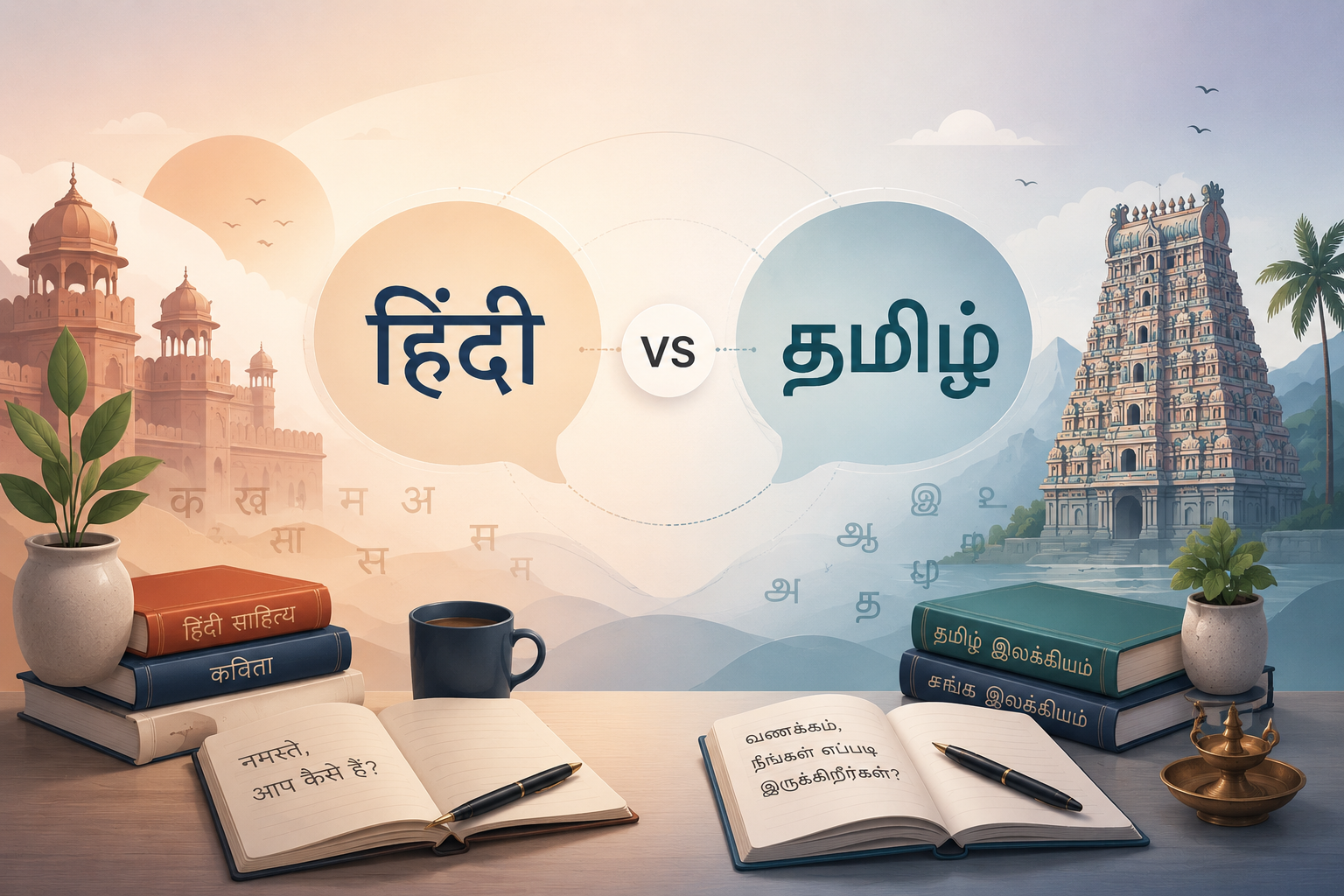
Hindi and Tamil are two of the most widely spoken languages in India, yet they come from entirely different language families. Hindi speakers make up the majority of North India, while Tamil dominates the South, particularly Tamil Nadu. Together, they represent over 700 million native speakers.
If you've ever wondered how these two languages compare, whether one is harder than the other, or what connects them despite their differences, this guide covers everything you need to know.
Origins: Two Different Language Families
The most fundamental difference between Hindi and Tamil is their origin.
Hindi belongs to the Indo-Aryan language family, a branch of the Indo-European family. It evolved from Sanskrit through Prakrit and Apabhramsha languages over centuries. Hindi shares roots with languages like Urdu, Bengali, Marathi, Gujarati, and Punjabi, and even distant relatives like English, Spanish, and Persian.
Tamil belongs to the Dravidian language family, which is entirely separate from Indo-European. Tamil is closely related to Telugu, Kannada, and Malayalam. The Dravidian family has no established connection to Indo-European languages, making Tamil and Hindi as linguistically distant as English and Japanese.
This is important to understand because it means Hindi and Tamil are not dialects of each other. They are fundamentally different languages with different grammar, vocabulary, phonology, and writing systems.
Age and Literary Heritage
Tamil is one of the oldest living languages in the world. The earliest Tamil inscriptions date back to the 3rd century BCE, and Sangam literature (300 BCE – 300 CE) represents one of the richest classical literary traditions in any language. Tamil was granted classical language status by the Indian government in 2004, the first language to receive this designation.
Hindi in its modern form is relatively younger. While its ancestor Sanskrit has ancient roots (the Rigveda dates to ~1500 BCE), modern Hindi as we know it began taking shape around the 10th century CE. Hindi literature flourished through the Bhakti and Sufi movements with poets like Kabir, Tulsidas, and Mirza Ghalib (who wrote in Urdu, Hindi's close sibling).
| Feature | Hindi | Tamil |
|---|---|---|
| Language Family | Indo-Aryan (Indo-European) | Dravidian |
| Ancestor Language | Sanskrit → Prakrit → Apabhramsha | Proto-Dravidian → Old Tamil |
| Classical Status | No (Sanskrit has it) | Yes (granted 2004) |
| Oldest Known Literature | ~10th century CE (modern Hindi) | ~3rd century BCE (Sangam literature) |
Script: Devanagari vs Tamil Script
Hindi is written in Devanagari (देवनागरी), a script used by several Indian languages including Sanskrit and Marathi. Devanagari has 11 vowels and 33 consonants, written left to right with a characteristic horizontal line (called a shirorekha) connecting the letters at the top.
Example in Hindi: नमस्ते, आप कैसे हैं? (Namaste, aap kaise hain? — Hello, how are you?)
Tamil uses its own Tamil script (தமிழ் எழுத்து), which has a rounded, curvilinear appearance. Tamil script has 12 vowels, 18 consonants, and one special character (ஃ), but through vowel-consonant combinations, produces 247 total characters. Tamil script is notable for being more phonetically streamlined than Devanagari.
Example in Tamil: வணக்கம், நீங்கள் எப்படி இருக்கிறீர்கள்? (Vanakkam, neengal eppadi irukkireergal? — Hello, how are you?)
The two scripts look completely different and share no visual similarity. A Hindi speaker cannot read Tamil script and vice versa without learning the other script from scratch.
Grammar: Structure and Rules
Both Hindi and Tamil follow SOV (Subject-Object-Verb) word order, which is one of the few structural similarities between them.
Example:
- Hindi: मैं चावल खाता हूँ (Main chawal khaata hoon) — I rice eat
- Tamil: நான் சோறு சாப்பிடுகிறேன் (Naan soru saappidugiren) — I rice eat
- English: I eat rice
But beyond word order, the grammar diverges significantly:
Gender
Hindi has grammatical gender (masculine and feminine) that affects nouns, adjectives, verbs, and postpositions. For example, "boy" (लड़का, ladka) is masculine, and "girl" (लड़की, ladki) is feminine, and verbs conjugate differently based on the subject's gender. This is one of the trickiest aspects for learners.
Tamil uses a rational/irrational (or person/non-person) gender system instead. Humans are classified by natural gender (masculine/feminine), while animals, objects, and abstract concepts are neuter. This is often considered more logical and easier for learners.
Verb Conjugation
Hindi verbs conjugate based on gender, number, and formality level. The same verb changes depending on whether the subject is male or female, singular or plural.
Tamil verbs conjugate based on person, number, and tense, but not gender in the same way as Hindi. Tamil has a rich system of verb suffixes and auxiliary verbs that convey tense, mood, and aspect.
Agglutination
Tamil is an agglutinative language, meaning it builds complex words by stringing together suffixes. A single Tamil word can convey what takes an entire Hindi or English phrase.
Example: போகமாட்டேன் (pogamatten) = "I will not go" — this single Tamil word contains the root "go" + negation + future tense + first person marker.
Hindi is less agglutinative and relies more on separate words and postpositions to express the same meaning: मैं नहीं जाऊँगा (main nahi jaaunga).
Vocabulary: Sanskrit vs Dravidian Roots
Hindi draws heavily from Sanskrit for its formal and literary vocabulary, and from Persian, Arabic, and Turkish for everyday words (a legacy of Mughal rule). This is why Hindi and Urdu are mutually intelligible in spoken form.
Tamil has consciously preserved its Dravidian vocabulary and resisted Sanskrit borrowings more than most other South Indian languages. The Tamil language purism movement (Thanith Thamizh Iyakkam) of the 20th century further strengthened this by coining native Tamil alternatives for Sanskrit-origin words.
That said, both languages do share some common words that entered through Sanskrit over millennia:
| English | Hindi | Tamil | Shared Root? |
|---|---|---|---|
| King | राजा (Raja) | அரசன் (Arasan) | No — different roots |
| Water | पानी (Paani) | தண்ணீர் (Thanneer) | No — different roots |
| Book | किताब (Kitaab) | புத்தகம் (Pusthagam) | No — Arabic vs Sanskrit |
| Teacher | गुरु (Guru) | குரு (Guru) | Yes — Sanskrit origin |
| Country | देश (Desh) | தேசம் (Desam) | Yes — Sanskrit origin |
Phonology: How They Sound
Hindi and Tamil sound very different to the ear, and for good reason — their sound systems evolved independently.
Hindi has aspirated consonants (like kh, gh, chh, jh, th, dh, ph, bh) which are critical for meaning. "kal" (कल, yesterday/tomorrow) vs "khal" (खल, wicked) are different words. Hindi also has nasal vowels and retroflex sounds inherited from Sanskrit.
Tamil has a distinctive set of retroflex, dental, and alveolar consonants but lacks aspirated consonants entirely. Tamil has the unique "zha" (ழ) sound that doesn't exist in any other major Indian language, famously difficult for non-Tamil speakers to pronounce. The word "Tamil" itself is properly pronounced "Tamizh" with this sound.
Cultural Significance
Both languages carry enormous cultural weight, but in very different ways.
Hindi serves as India's official language (alongside English) and functions as a lingua franca across much of the country. Bollywood, India's massive Hindi film industry, has made Hindi one of the most culturally influential languages in South Asia. Hindi is also the language of India's political discourse, with parliamentary proceedings often conducted in Hindi.
Tamil has one of the strongest language identity movements in the world. Tamil pride (Thamizh Pattru) is a defining feature of Tamil Nadu's cultural and political landscape. The language's ancient heritage, its classical literature, and the rich tradition of Tamil cinema (Kollywood) make it a source of immense pride. Tamil is also an official language in Sri Lanka, Singapore, and Malaysia.
Which One Should You Learn?
This depends entirely on your goals:
- Learn Hindi if: you want to communicate across the widest range of Indian states, work in North India, consume Bollywood content, or need a lingua franca for traveling across India.
- Learn Tamil if: you're moving to or working in Tamil Nadu, want to explore one of the world's oldest literary traditions, have Tamil-speaking family or friends, or plan to spend time in Sri Lanka or Singapore.
- Learn both if: you want to truly understand India's linguistic diversity. Speaking both a North Indian and South Indian language gives you a perspective on India that few people have.
Learn Hindi, Tamil, and More on Indilingo
Whether you choose Hindi, Tamil, or both, Indilingo makes learning Indian languages intuitive and effective. Our AI-powered platform lets you learn from your mother tongue, so a Tamil speaker learning Hindi gets the entire experience in Tamil, and vice versa.
With features like AI conversation practice, pronunciation feedback, interactive quizzes, and culturally rich lessons, you'll build real fluency, not just textbook knowledge.
Start learning today for free.
Download Indilingo on the Google Play Store and begin your journey.
Follow us on Instagram, X (Twitter), and LinkedIn for daily language insights.
Loved the Blog?
Take your language learning journey a step further.
Explore Indilingo - beautifully designed, easy to use, and built for Indian languages.