Hindi vs Bengali: Key Differences and Similarities
Author: Jay Gala | Date: May 20, 2026
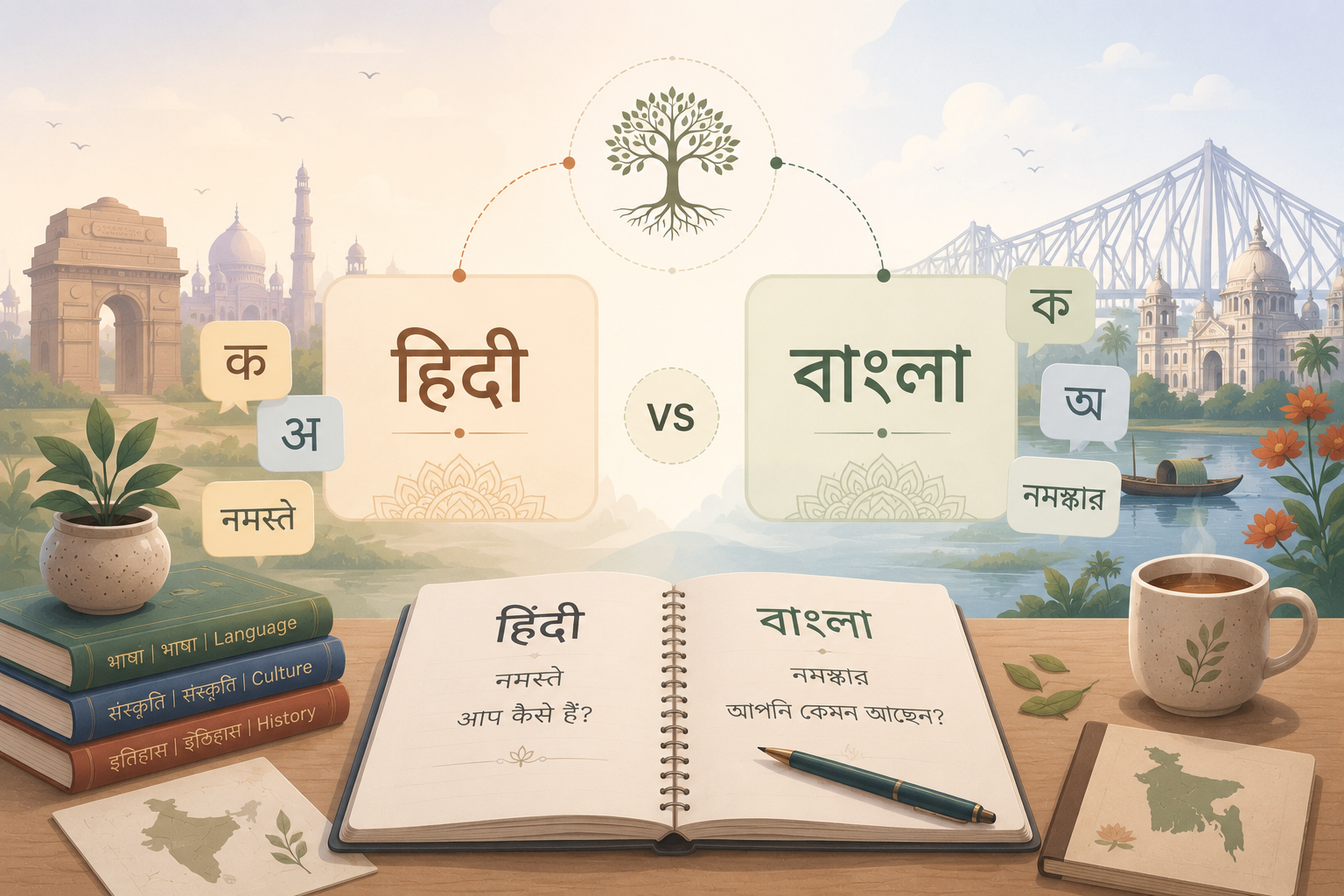
Hindi and Bengali are the two most spoken languages in India, with a combined speaker base of over 800 million people. Both descend from Sanskrit. Both use similar grammar. And yet, a Hindi speaker cannot understand spoken Bengali, and vice versa.
How can two languages from the same family be so different? And what do they still share beneath the surface? This guide dives deep into the comparison.
Origins: Same Great-Grandparent, Different Paths
Both Hindi and Bengali belong to the Indo-Aryan branch of the Indo-European language family. They share a common ancestor in Sanskrit, but they diverged over 1,000 years ago through different intermediate languages.
- Hindi evolved through Shauraseni Prakrit → Shauraseni Apabhramsha → Old Hindi → Modern Hindi
- Bengali evolved through Magadhi Prakrit → Magadhi Apabhramsha → Old Bengali → Modern Bengali
Think of them as cousins rather than siblings. They share a grandparent (Sanskrit via Prakrit), but grew up in different households — Hindi in the western Gangetic plains, Bengali in the eastern delta region.
| Feature | Hindi | Bengali |
|---|---|---|
| Language Family | Indo-Aryan (Central zone) | Indo-Aryan (Eastern zone) |
| Native Speakers | ~350 million | ~230 million |
| Total Speakers | ~600 million | ~300 million (incl. Bangladesh) |
| Ancestor Prakrit | Shauraseni | Magadhi |
| Script | Devanagari | Bengali (Eastern Nagari) |
| Official In | India (official language) | West Bengal (India) + Bangladesh |
A crucial distinction: Bengali is the national language of Bangladesh (population 170 million) in addition to being the official language of West Bengal. This makes Bengali the 7th most spoken language in the world — more speakers than French, German, or Korean.
Script: Devanagari vs Bengali Script
The most immediately visible difference between Hindi and Bengali is their writing systems.
Hindi uses Devanagari (देवनागरी), characterized by a horizontal line (shirorekha) running along the top of words, connecting letters together. Devanagari has 11 vowels and 33 consonants.
Example: आज मौसम बहुत अच्छा है। (Aaj mausam bahut achha hai. — The weather is very nice today.)
Bengali uses the Bengali script (বাংলা লিপি), also called Eastern Nagari. It evolved from the same Brahmi script ancestor as Devanagari, so if you look closely, you can spot family resemblances in some letters. Bengali script also has a headline, though it's less prominent. It has 11 vowels and 39 consonants.
Example: আজ আবহাওয়া খুব ভালো। (Aaj aabohawa khub bhalo. — The weather is very nice today.)
While both scripts descend from Brahmi, they look quite different to the untrained eye. However, a learner who already knows Devanagari will find Bengali script easier to pick up than, say, Tamil script — because the structural logic (vowel matras, consonant conjuncts, left-to-right writing) is the same.
Grammar: Surprisingly Similar Structure
This is where the family connection shines through. Hindi and Bengali share more grammatical DNA than most people realize.
Word Order
Both follow SOV (Subject-Object-Verb):
- Hindi: मैं चावल खाता हूँ (Main chawal khaata hoon) — I rice eat
- Bengali: আমি ভাত খাই (Ami bhaat khai) — I rice eat
Postpositions
Both use postpositions (words that come after the noun) instead of English-style prepositions:
- Hindi: मेज़ पर (mez par) — table on
- Bengali: টেবিলের উপর (tebiler upor) — table's on
The Big Difference: Gender
This is the most significant grammatical difference between the two:
Hindi has grammatical gender. Every noun is masculine or feminine, and verbs, adjectives, and postpositions change accordingly. "The boy ate" (लड़के ने खाया — ladke ne khaaya) uses a different verb form than "The girl ate" (लड़की ने खाया — ladki ne khaaya).
Bengali has no grammatical gender. Nouns are not classified as masculine or feminine. Verbs don't change based on the subject's gender. This makes Bengali grammar significantly simpler for learners in this respect.
For Hindi learners: this is often the hardest part. For Bengali learners: this problem simply doesn't exist.
Verb Conjugation
Both languages conjugate verbs, but with different systems:
Hindi conjugates by gender + number + tense + formality:
- वह खाता है (voh khaata hai — he eats) vs. वह खाती है (voh khaati hai — she eats)
Bengali conjugates by person + tense + formality level (three levels: intimate/তুই, familiar/তুমি, formal/আপনি):
- তুই খাস (tui khaas — you eat, intimate)
- তুমি খাও (tumi khao — you eat, familiar)
- আপনি খান (apni khan — you eat, formal)
Bengali's three-tier formality system is more nuanced than Hindi's two-tier system (तुम/आप), giving Bengali speakers finer control over the level of respect and intimacy in conversation.
Other Differences
| Feature | Hindi | Bengali |
|---|---|---|
| Grammatical Gender | Yes (masculine/feminine) | No |
| Formality Levels | 2 (तुम, आप) | 3 (তুই, তুমি, আপনি) |
| Articles | None | Has a definite article suffix (-টা / -ta) |
| Classifiers | Rarely used | Commonly used (টা, খানা, etc.) |
| Auxiliary Verbs | Uses होना (hona) | Uses হওয়া (howa) |
Vocabulary: Shared Roots, Divergent Evolution
Since both languages descended from Sanskrit, they share a large pool of cognates — words that come from the same root but evolved differently over time.
| English | Hindi | Bengali | Sanskrit Root |
|---|---|---|---|
| Water | पानी (paani) | জল / পানি (jol / paani) | पानीय / जल |
| Fire | आग (aag) | আগুন (aagun) | अग्नि (agni) |
| Book | किताब (kitaab) | বই (boi) | Different — Arabic vs native |
| Friend | दोस्त (dost) | বন্ধু (bondhu) | Different — Persian vs Sanskrit |
| Love | प्यार (pyaar) | ভালোবাসা (bhalobasha) | Different roots |
| Beautiful | सुंदर (sundar) | সুন্দর (shundor) | सुन्दर (sundara) |
| City | शहर (shehar) | শহর (shohor) | Same — Persian origin |
| Night | रात (raat) | রাত (raat) | रात्रि (raatri) |
| Eye | आँख (aankh) | চোখ (chokh) | Different evolution |
| Eat | खाना (khaana) | খাওয়া (khaowa) | Same root |
Roughly 40-50% of everyday vocabulary is recognizably related. But there's a twist: Hindi absorbed significantly more Persian, Arabic, and Turkish vocabulary (legacy of Mughal rule centered in Delhi), while Bengali retained more native Sanskrit-derived words and also borrowed from Portuguese and English (legacy of colonial Calcutta).
This means formal Hindi and formal Bengali actually sound more similar (both draw on Sanskrit for elevated vocabulary), while colloquial Hindi and colloquial Bengali diverge more significantly.
Pronunciation: How They Sound
Hindi and Bengali have distinct sound signatures:
Hindi has a strong distinction between aspirated and unaspirated consonants: क (ka) vs ख (kha), ग (ga) vs घ (gha). These aspirated sounds are essential for meaning — getting them wrong changes words entirely.
Bengali has a unique phonological feature: many consonants that are distinct in Hindi merge in Bengali. The most famous example:
- Hindi distinguishes between श (sha), ष (sha), and स (sa) — three different sounds
- Bengali merges all three into a single "sh" sound — শ, ষ, and স are all pronounced similarly
Similarly, Bengali merges several other consonant distinctions:
- জ (ja) and য (ya) sound nearly identical in Bengali
- The "va" (व) sound in Hindi becomes "bo" (ব) in Bengali — hence "Vishwakarma" in Hindi becomes "Bishwokorma" in Bengali
Bengali also has a distinctive nasal quality and a musical intonation pattern that gives it its famous poetic sound. The language's rhythm is often described as "wave-like," with a rise and fall that's quite different from Hindi's relatively flatter intonation.
Cultural Significance
Hindi Culture
Hindi is India's most widely understood language and the vehicle for Bollywood, the world's largest film industry by number of tickets sold. Hindi is also the language of India's political mainstream, with parliamentary proceedings, national news, and government communications largely in Hindi. The Bhakti and Sufi poetry traditions (Kabir, Tulsidas, Rahim) form the bedrock of Hindi's literary heritage.
Bengali Culture
Bengali culture punches far above its demographic weight. Rabindranath Tagore — who wrote the national anthems of both India and Bangladesh — wrote in Bengali. Satyajit Ray, one of cinema's greatest directors, made his films in Bengali. The Bengali Renaissance of the 19th-20th century produced a wave of intellectual, literary, and social reform that shaped modern India.
Bengalis are fiercely proud of their language — the Language Movement of 1952 in what was then East Pakistan (now Bangladesh) saw protesters die defending their right to speak Bengali. February 21 is now UNESCO's International Mother Language Day, commemorating that sacrifice. It's the only language in the world for which people gave their lives.
Bengali food culture (mishti doi, rasgulla, fish curry), Durga Puja celebrations, and the adda (intellectual conversation) tradition are all deeply woven into the linguistic identity.
Mutual Intelligibility: Can They Understand Each Other?
In writing: No, because the scripts are different.
In speech: Partially, with effort. A Hindi speaker listening to slow, formal Bengali can catch roughly 20-30% of content through shared Sanskrit vocabulary. Informal, fast-paced Bengali is largely incomprehensible to Hindi-only speakers.
One-way advantage: Bengali speakers in India typically understand Hindi much better than Hindi speakers understand Bengali — because Bengali speakers are exposed to Hindi through Bollywood, national media, and practical necessity. The reverse exposure doesn't exist.
Which One Should You Learn?
- Learn Hindi if: You want maximum reach across India, you love Bollywood, you're working in North or Central India, or you need a lingua franca for traveling across multiple states.
- Learn Bengali if: You're moving to Kolkata, you have Bengali family connections, you love literature and cinema (Tagore, Ray, and modern Bengali cinema are treasures), you're interested in Bangladesh, or you want to learn a language with no grammatical gender headaches.
- Learn both if: You want to unlock India's two largest linguistic communities. Since they share grammar structures and vocabulary roots, knowing one makes the other significantly easier.
Learn Hindi and Bengali on Indilingo
Whether you choose Hindi, Bengali, or both, Indilingo makes the journey intuitive. Learn Hindi from Bengali or Bengali from Hindi — our AI-powered platform adapts entirely to your mother tongue.
With AI conversation practice, pronunciation feedback, interactive quizzes, and culturally rich content, you'll build real conversational skills — not just textbook knowledge.
Start learning for free.
Download Indilingo on the Google Play Store.
Follow us on Instagram, X (Twitter), and LinkedIn for daily language insights.
Loved the Blog?
Take your language learning journey a step further.
Explore Indilingo - beautifully designed, easy to use, and built for Indian languages.