A Foreigner's Guide to Indian Languages: Which One Should You Learn?
Author: Jay Gala | Date: May 20, 2026
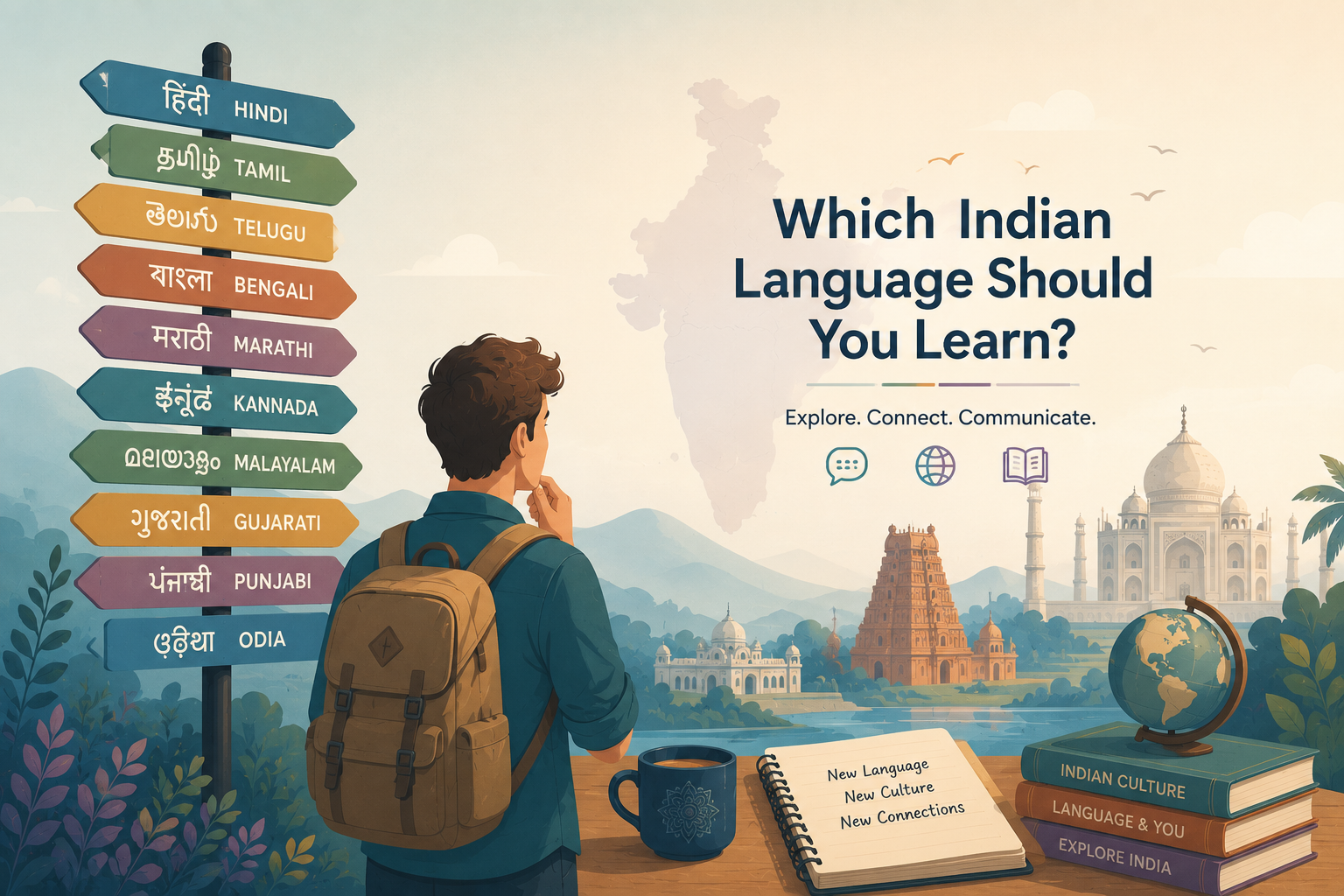
India has 22 officially recognized languages, hundreds of dialects, and over a billion speakers. If you're not from India, that can feel overwhelming. Where do you even start?
The truth is, there's no single "best" Indian language to learn. The right choice depends entirely on why you want to learn, where you'll use it, and what you're drawn to. This guide breaks it all down so you can make an informed decision.
First: A Quick Map of India's Languages
India's languages fall into two major families:
Indo-Aryan languages (North India): Hindi, Bengali, Marathi, Gujarati, Punjabi, Odia, Urdu. These evolved from Sanskrit and share some common vocabulary, much like how Spanish, French, and Italian share Latin roots.
Dravidian languages (South India): Tamil, Telugu, Kannada, Malayalam. These are an entirely separate language family with no connection to Indo-Aryan languages. Think of the difference as similar to English vs Japanese — completely different origins.
This is important because learning one Indo-Aryan language makes others easier, and the same goes for Dravidian languages. But crossing between the two families means starting almost from scratch.
Choose Based on Your Goal
If you want to communicate with the most people...
Learn: Hindi
Hindi is understood by roughly 600-700 million people across India and is the closest thing India has to a lingua franca. If you can only learn one Indian language, Hindi gives you the widest reach. You'll be understood in Delhi, Mumbai, Jaipur, Lucknow, Varanasi, and most of North and Central India.
Who it's for: Travelers exploring multiple Indian states, business professionals working across India, anyone who wants maximum communication coverage.
Difficulty: Moderate. The Devanagari script is phonetic and learnable in a week. Grammar has gender (every noun is masculine or feminine) which takes getting used to, but sentence structure (Subject-Object-Verb) is consistent.
If you're moving to or working in South India...
Learn: Tamil, Telugu, or Kannada (depending on the state)
Hindi won't help you much in Tamil Nadu, and some people actively prefer you don't assume they speak it. Learning the local language is both practical and respectful.
- Tamil Nadu / Chennai → Tamil. One of the world's oldest languages (2,000+ year literary tradition). Tamil speakers are fiercely proud of their language and culture. Speaking even basic Tamil will earn you enormous respect.
- Andhra Pradesh / Telangana / Hyderabad → Telugu. The most spoken Dravidian language by native speakers. Called the "Italian of the East" for its melodic, vowel-heavy sound.
- Karnataka / Bengaluru → Kannada. Bengaluru is India's tech capital and attracts people from everywhere. But the local language is Kannada, and learning it transforms your experience from "expat bubble" to genuine connection with the city.
- Kerala → Malayalam. If you're heading to Kerala — whether for its backwaters, Ayurveda retreats, or tech jobs in Kochi and Thiruvananthapuram — Malayalam is what you need.
If you love literature and poetry...
Learn: Bengali or Urdu
Bengali gave the world Rabindranath Tagore (the first non-European Nobel Prize winner in Literature) and Satyajit Ray (one of cinema's greatest directors). Bengali literature is among the richest in the world, and the language has a poetic quality that Bengali speakers are immensely proud of.
Urdu is the language of ghazals, qawwalis, and some of the most beautiful poetry ever written. Mirza Ghalib, Faiz Ahmed Faiz, and Allama Iqbal wrote in Urdu. If you love Sufi music or Bollywood lyrics, you're already drawn to Urdu. Bonus: spoken Urdu and Hindi are mutually intelligible, so learning one gives you a strong head start on the other.
If you're into Bollywood and Indian pop culture...
Learn: Hindi (and then Urdu for the poetry)
Bollywood films, which dominate Indian and South Asian pop culture globally, are primarily in Hindi. Many iconic dialogues, songs, and cultural references come from Hindi cinema. If you already watch Bollywood with subtitles, learning Hindi will let you appreciate the wordplay, humor, and emotional nuance that translations can't capture.
Fun fact: Many Bollywood lyrics use Urdu words for their poetic quality. Learning basic Urdu vocabulary alongside Hindi will unlock an entirely new layer of understanding in film songs.
If you practice yoga or study Indian philosophy...
Learn: Sanskrit (and then Hindi for practical use)
The Bhagavad Gita, Yoga Sutras of Patanjali, Upanishads, and Vedas are all in Sanskrit. While Sanskrit isn't a spoken daily language, learning it gives you direct access to these texts without relying on translations. Many yoga terms you already know — asana, pranayama, chakra, mantra, dharma, karma — are Sanskrit words.
For practical daily communication alongside your philosophical studies, pair Sanskrit with Hindi, since Hindi derives much of its formal vocabulary from Sanskrit.
If you're doing business in India...
Learn: Hindi + the language of the state you're working in
English is widely used in Indian business, especially in tech, finance, and multinational companies. But speaking the local language — even at a basic level — is a massive competitive advantage. It builds trust, shows respect, and opens doors that English alone cannot.
- Mumbai → Hindi + Marathi
- Bengaluru → Hindi + Kannada
- Chennai → Tamil (Hindi is less common here)
- Hyderabad → Hindi + Telugu
- Kolkata → Hindi + Bengali
- Ahmedabad → Hindi + Gujarati
If you have Indian family or a partner...
Learn: Their mother tongue
This is the easiest decision. If your partner is Tamil, learn Tamil. If your in-laws speak Gujarati, learn Gujarati. Nothing builds family bonds faster than speaking someone's mother tongue. Even if your partner speaks perfect English, switching to their language at home changes the relationship in ways that are hard to describe until you experience it.
Quick Comparison: India's Top Languages at a Glance
| Language | Speakers | Region | Script | Difficulty* | Best For |
|---|---|---|---|---|---|
| Hindi | 600M+ | North/Central India | Devanagari | Moderate | Widest reach, Bollywood, travel |
| Tamil | 80M+ | Tamil Nadu, Sri Lanka | Tamil | Hard | Ancient culture, Chennai, literature |
| Telugu | 85M+ | Andhra Pradesh, Telangana | Telugu | Moderate | Hyderabad, Tollywood, melodic speech |
| Bengali | 100M+ | West Bengal, Bangladesh | Bengali | Moderate | Literature, arts, Kolkata |
| Marathi | 83M+ | Maharashtra | Devanagari | Moderate | Mumbai, Pune, business |
| Kannada | 45M+ | Karnataka | Kannada | Moderate | Bengaluru, tech industry |
| Malayalam | 38M+ | Kerala | Malayalam | Hard | Kerala, healthcare, Gulf diaspora |
| Gujarati | 55M+ | Gujarat | Gujarati | Moderate | Business, diaspora connections |
| Punjabi | 50M+ | Punjab | Gurmukhi | Moderate | Music, culture, diaspora |
| Urdu | 70M+ | Across India, Pakistan | Nastaliq | Moderate | Poetry, music, Bollywood lyrics |
*Difficulty is relative to an English speaker with no prior Indian language experience.
FAQ: Questions Foreigners Always Ask
Do I need to learn an Indian language? Doesn't everyone speak English?
English is widely spoken in cities, the tech industry, and educated circles. You can survive in India without learning any Indian language. But "survive" and "thrive" are very different things. Speaking the local language transforms every interaction — from transactional to personal — and gives you access to the real India that tourists and English-only expats never see.
Is Hindi the "main" language of India?
Hindi is India's most widely spoken language but it's not "the" language of India. India has no single national language. Hindi and English are both official languages of the central government, and each state has its own official language(s). In South India especially, Hindi is not the default, and assuming it is can be culturally insensitive.
Can I learn an Indian language without knowing the script?
You can start with romanization (writing the language in English letters), but you'll hit a ceiling quickly. Scripts are phonetic in Indian languages — once you learn them (usually 1-2 weeks), you can pronounce any word correctly just by reading it. That's actually easier than English, where "through," "though," "thought," and "thorough" all sound completely different despite looking similar.
How long does it take to become conversational?
With consistent daily practice (30-45 minutes):
- 1 month: Basic greetings, introductions, simple transactions
- 3 months: Short conversations on familiar topics
- 6 months: Comfortable daily conversations
- 1 year: Confident in most social and professional situations
Start Learning Today
You don't need to figure out everything before you start. Pick a language based on this guide, download Indilingo, and begin with Lesson 1. The app handles the rest — structured curriculum, AI conversation practice, pronunciation feedback, and culturally rich content that makes learning feel natural.
The best part: Indilingo lets you learn from any language you already speak. So if you're a French speaker learning Tamil, or a Japanese speaker learning Hindi, the entire app adapts to your base language.
Download Indilingo for free on the Google Play Store and start your Indian language journey today.
Follow us on Instagram, X (Twitter), and LinkedIn for language learning tips and cultural insights.
Loved the Blog?
Take your language learning journey a step further.
Explore Indilingo - beautifully designed, easy to use, and built for Indian languages.