Common Hindi Phrases for Beginners: 50 Essential Expressions
Author: Jay Gala | Date: May 20, 2026
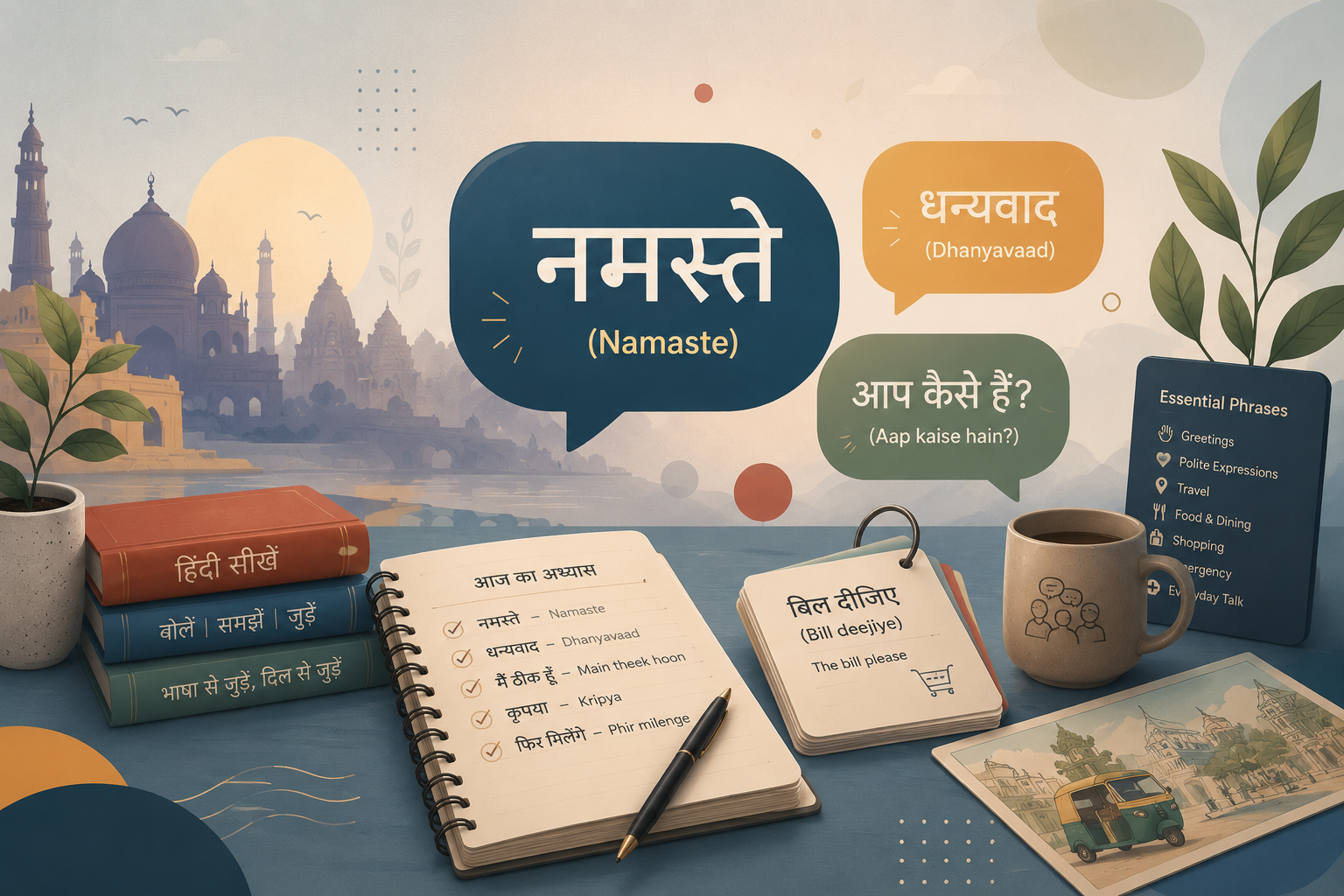
Hindi is spoken by over 600 million people and is understood across most of India. Whether you're planning a trip to Delhi, working with Hindi-speaking colleagues, or just starting your language learning journey, these 50 essential phrases will help you navigate real conversations from day one.
Each phrase includes the Devanagari script, a romanized pronunciation guide, and cultural context so you know not just what to say but when and how to say it.
Greetings and Basic Courtesy
Greetings in Hindi change based on the time of day, the relationship between speakers, and the level of formality. Here are the ones you'll use most:
| # | English | Hindi | Pronunciation |
|---|---|---|---|
| 1 | Hello / Greetings | नमस्ते | Nuh-mus-tay |
| 2 | How are you? (formal) | आप कैसे हैं? | Aap kai-say hain? |
| 3 | I'm fine | मैं ठीक हूँ | Main theek hoon |
| 4 | Good morning | सुप्रभात | Su-pra-bhaat |
| 5 | Good night | शुभ रात्रि | Shubh raa-tri |
| 6 | Goodbye | अलविदा | Al-vi-daa |
| 7 | See you later | फिर मिलेंगे | Phir mi-len-gay |
Cultural tip: "Namaste" (नमस्ते) is universal and works in any situation — formal meetings, casual encounters, greeting elders, or meeting strangers. It literally means "I bow to you" and is accompanied by pressing your palms together. Unlike English where you need different greetings for different times, Namaste works 24/7.
Polite Expressions
Politeness in Hindi is expressed not just through words but through verb forms. Hindi has a formal "you" (आप, aap) and informal "you" (तुम, tum / तू, tu). Always use आप with strangers, elders, and in professional settings.
| # | English | Hindi | Pronunciation |
|---|---|---|---|
| 8 | Thank you | धन्यवाद | Dhun-yuh-vaad |
| 9 | Thank you (casual) | शुक्रिया | Shuk-ree-yah |
| 10 | Please | कृपया | Kri-puh-yaa |
| 11 | Sorry / Excuse me | माफ़ कीजिए | Maaf kee-ji-yay |
| 12 | No problem | कोई बात नहीं | Koi baat na-heen |
| 13 | You're welcome | आपका स्वागत है | Aap-ka swa-gat hai |
Cultural tip: "Koi baat nahi" (कोई बात नहीं) literally means "it's nothing" and is one of the most used phrases in Hindi. You'll hear it as a response to thank you, sorry, or any minor inconvenience. It reflects the Indian cultural value of not making a big deal out of small favors.
Introducing Yourself
| # | English | Hindi | Pronunciation |
|---|---|---|---|
| 14 | My name is... | मेरा नाम ... है | Me-ra naam ... hai |
| 15 | What is your name? | आपका नाम क्या है? | Aap-ka naam kya hai? |
| 16 | Nice to meet you | आपसे मिलकर खुशी हुई | Aap-say mil-kar khu-shee hui |
| 17 | Where are you from? | आप कहाँ से हैं? | Aap ka-haan say hain? |
| 18 | I am from... | मैं ... से हूँ | Main ... say hoon |
| 19 | I am learning Hindi | मैं हिंदी सीख रहा/रही हूँ | Main Hindi seekh ra-ha/ra-hee hoon |
Cultural tip: Phrase #19 is your secret weapon. Telling someone "Main Hindi seekh raha hoon" instantly changes the dynamic — people become patient, encouraging, and often excited to help you practice. Indians deeply appreciate the effort of learning their language.
Getting Around and Travel
These phrases are essential for navigating Indian cities, whether you're hailing an auto-rickshaw, asking for directions, or negotiating at a market.
| # | English | Hindi | Pronunciation |
|---|---|---|---|
| 20 | Where is...? | ... कहाँ है? | ... ka-haan hai? |
| 21 | How far is it? | कितनी दूर है? | Kit-nee door hai? |
| 22 | Go straight | सीधे जाइए | See-dhay jaa-i-yay |
| 23 | Turn left | बाएँ मुड़िए | Baa-yen mu-ri-yay |
| 24 | Turn right | दाएँ मुड़िए | Daa-yen mu-ri-yay |
| 25 | Stop here | यहाँ रुकिए | Ya-haan ru-ki-yay |
| 26 | I want to go to... | मुझे ... जाना है | Mu-jhay ... jaa-na hai |
| 27 | How much time will it take? | कितना समय लगेगा? | Kit-na sa-may la-gay-ga? |
Cultural tip: "Yahan rukiye" (यहाँ रुकिए) — stop here — might be the single most useful phrase for anyone taking auto-rickshaws or cabs in India. Combine it with "Kitna hua?" (कितना हुआ? — How much?) when you arrive at your destination.
Food and Dining
Food is central to Indian culture, and knowing these phrases will transform your dining experience from pointing at menus to having real conversations.
| # | English | Hindi | Pronunciation |
|---|---|---|---|
| 28 | I am hungry | मुझे भूख लगी है | Mu-jhay bhookh la-gee hai |
| 29 | I am thirsty | मुझे प्यास लगी है | Mu-jhay pyaas la-gee hai |
| 30 | Water | पानी | Paa-nee |
| 31 | The food is delicious | खाना बहुत स्वादिष्ट है | Khaa-na ba-hut swaa-disht hai |
| 32 | I don't eat meat | मैं माँस नहीं खाता/खाती | Main maans na-heen khaa-ta/khaa-tee |
| 33 | Not too spicy please | ज़्यादा तीखा मत बनाइए | Zyaa-da tee-kha mat ba-naa-i-yay |
| 34 | The bill please | बिल दीजिए | Bill dee-ji-yay |
| 35 | One more, please | एक और दीजिए | Ek aur dee-ji-yay |
Cultural tip: Complimenting the food with "Khana bahut swadisht hai" will make any host's day. In Indian households, feeding guests well is a matter of pride, and acknowledging good food is one of the highest compliments you can give. Also, "Not too spicy" (#33) will save you — Indian "medium spicy" can be quite intense for beginners!
Shopping and Numbers
| # | English | Hindi | Pronunciation |
|---|---|---|---|
| 36 | How much does this cost? | यह कितने का है? | Yeh kit-nay ka hai? |
| 37 | Too expensive | बहुत महँगा है | Ba-hut ma-han-ga hai |
| 38 | Give me a discount | कुछ कम कीजिए | Kuch kam kee-ji-yay |
| 39 | I'll take it | मैं यह ले लूँगा/लूँगी | Main yeh lay loon-ga/loon-gee |
| 40 | I don't need it | मुझे नहीं चाहिए | Mu-jhay na-heen chaa-hi-yay |
Cultural tip: Bargaining is expected at street markets, local shops, and auto-rickshaw stands. "Bahut mehanga hai" followed by "Kuch kam kijiye" is the classic opening move. A friendly smile while negotiating goes a long way.
Emergency and Essential Phrases
| # | English | Hindi | Pronunciation |
|---|---|---|---|
| 41 | Help! | मदद कीजिए! | Ma-dad kee-ji-yay! |
| 42 | I don't understand | मुझे समझ नहीं आया | Mu-jhay sa-majh na-heen aa-ya |
| 43 | Please speak slowly | कृपया धीरे बोलिए | Kri-puh-yaa dhee-ray bo-li-yay |
| 44 | Do you speak English? | क्या आप अंग्रेज़ी बोलते हैं? | Kya aap an-gre-zee bol-tay hain? |
| 45 | I need a doctor | मुझे डॉक्टर चाहिए | Mu-jhay doc-tar chaa-hi-yay |
| 46 | Where is the hospital? | अस्पताल कहाँ है? | As-pa-taal ka-haan hai? |
Everyday Conversation
| # | English | Hindi | Pronunciation |
|---|---|---|---|
| 47 | Yes | हाँ | Haan |
| 48 | No | नहीं | Na-heen |
| 49 | I like this | मुझे यह पसंद है | Mu-jhay yeh pa-sand hai |
| 50 | What is this? | यह क्या है? | Yeh kya hai? |
Tips for Learning Hindi Faster
Now that you have 50 phrases to start with, here's how to actually retain them and build fluency:
- Learn the Devanagari script first. It looks intimidating but is actually phonetic and logical. Once you can read it, you can pronounce any Hindi word correctly. This takes most learners just 1-2 weeks.
- Practice with native speakers. Hindi speakers are among the most encouraging language partners you'll find. Most will patiently repeat themselves, correct your pronunciation, and genuinely appreciate your effort.
- Watch Bollywood with subtitles. Start with subtitles in English, then switch to Hindi subtitles as you improve. Films like Dil Chahta Hai, Zindagi Na Milegi Dobara, and 3 Idiots use conversational Hindi that's perfect for learners.
- Don't stress about gender. Hindi grammatical gender (masculine/feminine for every noun) is one of the hardest parts. You'll make mistakes. Native speakers will still understand you perfectly.
- Use phrases in context, not isolation. Don't just memorize — use each phrase in a real or simulated situation. Order food in Hindi, greet your Uber driver, or practice with an AI tutor.
Start Speaking Hindi Today
These 50 phrases are your foundation, but real fluency comes from practice. Indilingo's AI-powered app takes you from basic phrases to full conversations through interactive lessons, pronunciation feedback, and AI conversation partners that adapt to your level.
The best part? You can learn Hindi from your mother tongue — Tamil, Telugu, Kannada, Bengali, Marathi, or any other language you're comfortable with. No English required.
Download Indilingo for free on the Google Play Store and start your Hindi journey today.
Follow us on Instagram, X (Twitter), and LinkedIn for daily Hindi words and language tips.
Loved the Blog?
Take your language learning journey a step further.
Explore Indilingo - beautifully designed, easy to use, and built for Indian languages.